
You are planning to take a home loan or already paying an EMI, and suddenly interest rates change leaving you confused. This is where the RBI repo rate becomes crucial.
As per Reserve Bank of India, the repo rate directly influences lending rates across banks like State Bank of India, HDFC Bank, and ICICI Bank. Even a small 0.25% change can impact your EMI by thousands of rupees annually.
But understanding repo rate isn’t as simple as “rate up = EMI up.” There are timing delays, loan types, and banking mechanisms like EBLR and MCLR that complicate things.
In this detailed guide, you’ll learn:
- What the RBI repo rate is (in simple terms)
- Latest repo rate in 2026 with real numbers
- How it affects your home loan EMI
- Repo vs reverse repo vs MCLR
- Practical examples for Indian borrowers
What is RBI Repo Rate
The RBI repo rate is the interest rate at which the Reserve Bank of India lends money to commercial banks against government securities.
Simple Example
Let’s say:
- HDFC Bank needs ₹1,000 crore
- It borrows from RBI at 5.25% repo rate
That means the bank pays interest to RBI and then lends money to you at a higher rate (say 8.5%).
Why This Matters
This rate controls:
- Inflation
- Liquidity in the economy
- Loan interest rates
If RBI increases repo rate → loans become expensive
If RBI reduces repo rate → loans become cheaper
That’s why your home loan EMI changes even if your bank hasn’t “officially” increased rates yet.
Current RBI Repo Rate in 2026
As of early 2026:
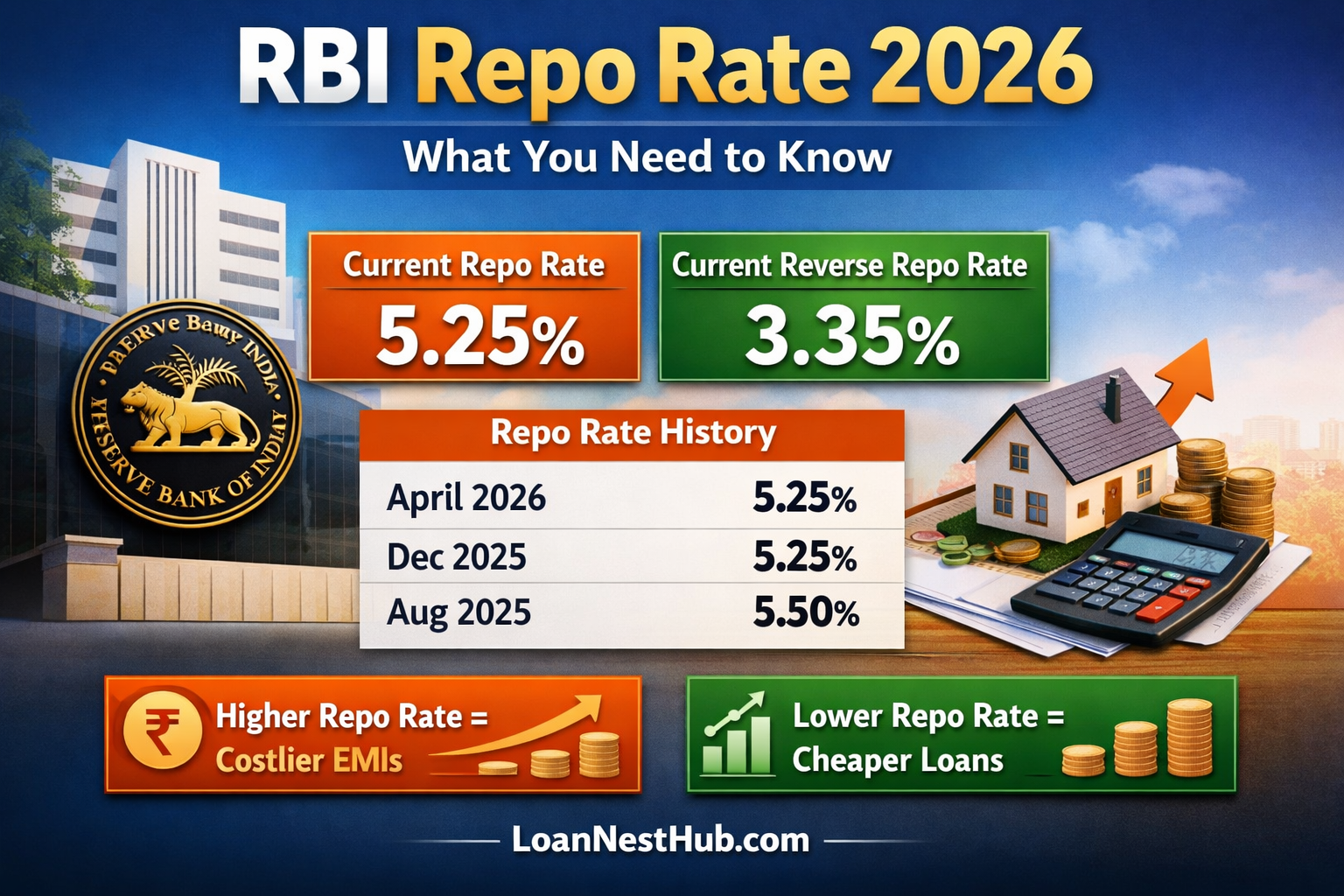
- Repo Rate: 5.25%
- Reverse Repo Rate: 3.35%
- Standing Deposit Facility: 5.00%
- MSF Rate: 5.50%
In December 2025, RBI reduced repo rate by 25 basis points (0.25%), signaling support for economic growth.
Why RBI Cut Rates
- Inflation under control (~2–4%)
- GDP growth stable (~7%+)
- Need to boost borrowing and consumption
What It Means for You
If you have a repo-linked home loan (EBLR):
- Your EMI likely reduced within 3 months
- Banks revise rates quarterly as per RBI guidelines
Use home loan EMI calculator India to check your savings.
How RBI Repo Rate Works
The RBI repo rate works as a monetary policy tool to control inflation and growth.
Scenario 1: Inflation is High
- RBI increases repo rate (e.g., 6.50%)
- Banks borrow at higher cost
- Loans become expensive
- Spending reduces
- Inflation comes down
Scenario 2: Economy is Slow
- RBI reduces repo rate (e.g., 5.25%)
- Banks borrow cheaper
- Loans become affordable
- People spend more
- Economy grows
Real Indian Example
In 2020 (COVID period):
- Repo rate dropped to 4.00%
- Home loan rates fell below 7%
- Property demand surged in cities like Pune, Mumbai
This is why timing your home loan with repo rate cycles can save lakhs.
Impact of RBI Repo Rate on Home Loans
This is where most borrowers care your EMI.
Example Calculation
Loan Amount: ₹50 lakh
Interest Rate: 8.5%
Tenure: 20 years
EMI ≈ ₹43,391
Now, if repo rate increases by 0.50% → loan rate becomes 9%
New EMI ≈ ₹44,986
Difference: ₹1,595/month = ₹3.8 lakh extra over tenure
Key Insight
- Repo rate changes directly impact EBLR loans
- MCLR loans adjust slower (6–12 months delay)
Which Loans Are Affected?
- Home loans
- Personal loans
- Car loans
- Business loans
Check repo linked home loan vs MCLR to understand which is better.
Repo Rate vs Reverse Repo Rate vs MCLR
| Parameter | Repo Rate | Reverse Repo Rate | MCLR |
|---|---|---|---|
| Defined by | RBI | RBI | Banks |
| Current Value (2026) | 5.25% | 3.35% | ~8–9% |
| Purpose | Lending to banks | Borrowing from banks | Loan pricing |
| Impact on EMI | Direct (EBLR loans) | Indirect | Moderate |
| Revision Frequency | RBI policy | RBI policy | Monthly/quarterly |
Key Difference Explained
- Repo Rate → RBI → Banks
- Reverse Repo Rate → Banks → RBI
- MCLR → Bank internal benchmark
Today, most new loans are linked to repo rate (EBLR), making it more important than ever.
Repo Rate History in India
Here’s a simplified trend:
- 2008: ~9.00% (high inflation)
- 2016: ~6.25%
- 2020: 4.00% (record low)
- 2023–24: ~6.50%
- 2025: Reduced to 5.25%
What You Should Learn
- Repo rate moves in cycles
- Low rates = good time to take loans
- High rates = good time to invest
Practical Tip
If repo rate is near peak (like 6.5%+), wait if possible.
If repo rate is falling → best time to lock a home loan.
Expert Tips for Borrowers
1. Choose Repo-Linked Loans (EBLR)
They respond faster to RBI changes. You benefit quicker when rates fall.
2. Check Reset Frequency
Banks revise rates every 3 months not instantly.
3. Avoid Fixed Rate for Long Tenure
Fixed rates are usually higher by 1-2%. Not ideal unless rates are very low.
4. Track RBI MPC Meetings
RBI announces changes every 2 months. Stay updated.
5. Refinance When Rates Drop
Switch loan if difference is 0.50%+ saves lakhs.
6. Understand FOIR Meaning
Banks check your Fixed Obligation to Income Ratio before approving loans.
FAQs
1. What is RBI repo rate in simple words?
The RBI repo rate is the interest rate at which the Reserve Bank of India lends money to banks. It affects loan interest rates across India.
2. What is the current RBI repo rate in 2026?
As of early 2026, the repo rate is 5.25%, after a rate cut in December 2025.
3. How does RBI repo rate affect home loan EMI?
When repo rate increases, your EMI increases. When it decreases, your EMI reduces especially for repo-linked loans.
4. Is repo rate better than MCLR for home loans?
Yes, repo-linked loans (EBLR) are more transparent and adjust faster compared to MCLR-based loans.
5. How often does RBI change repo rate?
RBI reviews repo rate every 2 months during Monetary Policy Committee meetings.
Conclusion
Understanding the RBI repo rate helps you make smarter loan decisions.
Key Takeaways:
- Repo rate directly affects your home loan EMI
- Current rate (2026): 5.25%
- Repo-linked loans adjust faster than MCLR
- Rate cycles matter timing can save lakhs
Before taking a loan, always calculate your EMI and future rate impact.
Use LoanNestHub tools like home loan eligibility calculator India to plan better and avoid surprises.