
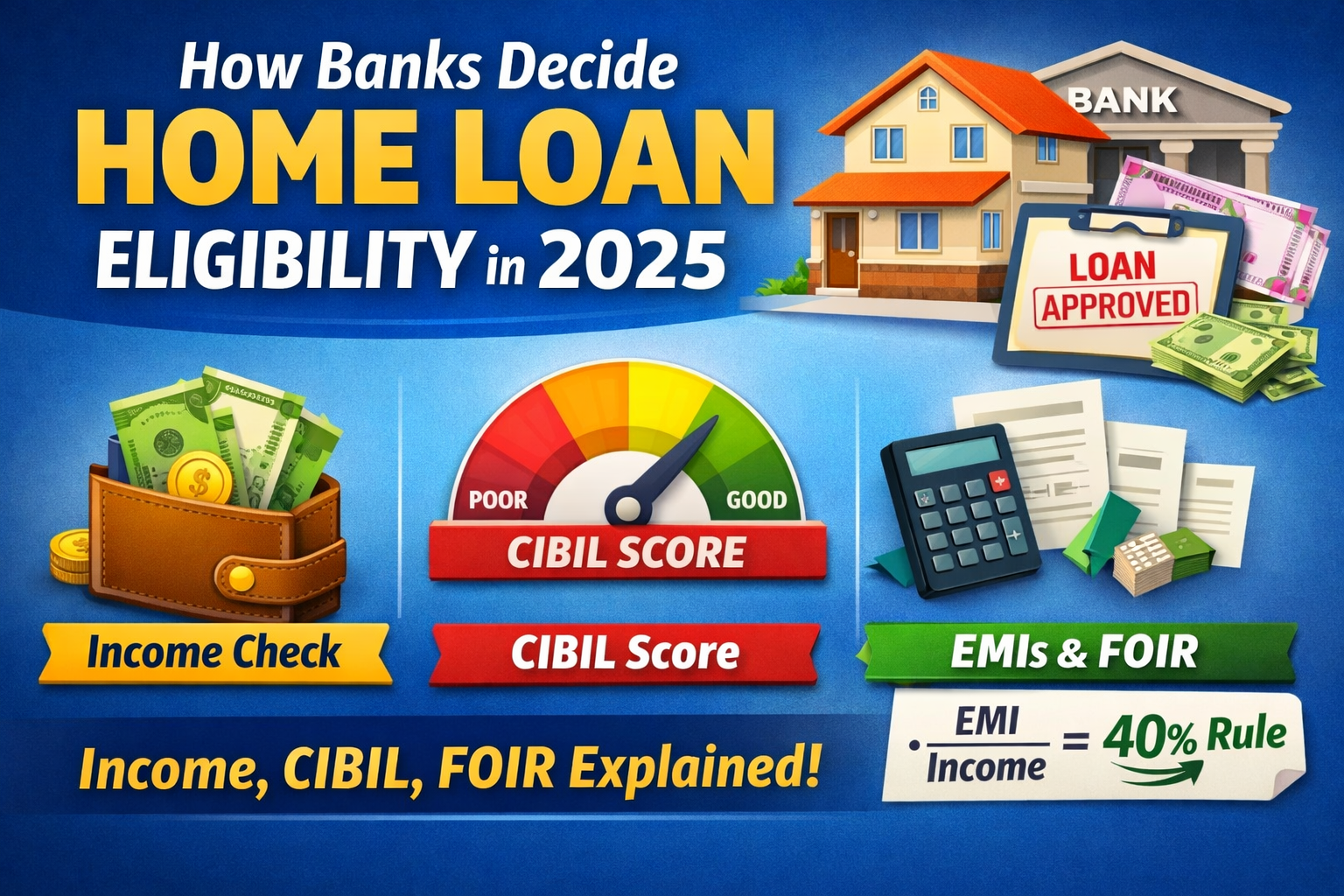
Planning to buy a home in 2025? Before you shortlist flats or talk to builders, there’s one number that quietly decides everything – your home loan eligibility.
Whether you apply with SBI, HDFC, ICICI, Axis, or Kotak, banks follow a surprisingly similar logic to decide how much you can borrow – and why many applications get reduced or rejected.
This updated 2025 eligibility guide explains the exact approval rules, real-world bank behaviour, and what truly increases your chances – before you apply.
Minimum Income Required for Home Loan (2025)
There is no single “official” salary rule in India. However, most banks follow these widely used benchmarks:
✔ Metro cities: ₹25,000 per month
✔ Tier-2 & Tier-3 cities: ₹15,000–18,000 per month
Your income doesn’t directly decide the loan amount. What matters is how much EMI you can safely afford.
How Banks Estimate Maximum Loan from Income
| Net Monthly Income | Approx Eligible Loan |
|---|---|
| ₹20,000 | ₹12-15 lakh |
| ₹30,000 | ₹20-25 lakh |
| ₹40,000 | ₹28-32 lakh |
| ₹50,000 | ₹35-40 lakh |
| ₹70,000 | ₹45-55 lakh |
| ₹1,00,000 | ₹70 lakh+ |
📌 Reality check: Salary alone doesn’t decide approval. Banks mainly care about how much of your income is already locked in EMIs – this is called FOIR.
CIBIL Score Requirement for Home Loan
Your CIBIL score tells the bank how disciplined you are with credit. In 2025, it’s one of the strongest approval signals.
✔ Ideal score: 750–900
✔ Minimum considered: 700
Higher CIBIL scores usually unlock:
- Faster approval
- Lower interest rates
- Higher loan eligibility
Home Loan Approval Chances by CIBIL Score
| CIBIL Range | Approval Strength | Interest Rate Impact |
|---|---|---|
| 800-900 | Excellent | Lowest available |
| 750-799 | Strong | Very competitive |
| 700-749 | Moderate | Slightly higher |
| <700 | Weak | High rejection risk |
📌 Bank insight: Even with good income, a low CIBIL score can trigger instant rejection.
Age Criteria for Home Loan
Age decides your loan tenure – and indirectly your EMI.
✔ Minimum age: 21 years
✔ Maximum age at loan end:
- Salaried: 60 years
- Self-employed: 70 years
Younger borrowers usually get:
- Longer tenure
- Lower EMI
- Higher eligibility
📌 Smart move: Adding a younger co-applicant can boost eligibility instantly.
FOIR – The Hidden Approval Killer
FOIR (Fixed Obligation to Income Ratio) measures how much of your income is already committed to EMIs.
Formula:
FOIR = (Existing EMIs + New EMI) ÷ Net Monthly Income
Banks prefer FOIR ≤ 40-50%
Example:
Income: ₹50,000
Total EMI: ₹20,000 → FOIR = 40% ✔
If FOIR crosses 55-60%, banks usually reduce loan amount or reject the file.
Employment & Income Stability Rules

Salaried Applicants
- 6 months in current job
- 1-2 years total experience
- Regular salary credit
- No unexplained job hopping
Self-Employed Applicants
- 3 years ITR
- Audited financials
- GST returns (if applicable)
- Stable income trend
📌 HDFC & ICICI are relatively flexible with self-employed income. SBI demands stricter documentation.
Property Eligibility – Often Ignored
Even a perfect borrower can get rejected if the property fails checks.
- RERA registration
- Clear title
- Approved layout
- Builder reputation
- Completion / OC certificate
📌 Under-construction projects often get lower LTV due to higher risk.
How to Increase Home Loan Eligibility
✔ Improve CIBIL above 750
✔ Close small loans
✔ Increase down payment (20-25%)
✔ Opt for longer tenure
✔ Add co-applicant
✔ Avoid multiple loan enquiries
✔ Keep credit card usage below 40%
Why Use a Home Loan Eligibility Calculator?
Eligibility calculators simulate real bank logic and help you avoid rejection surprises.
Our Home Loan Eligibility Calculator gives an instant, realistic estimate based on income, EMIs, age, tenure, and interest rates.
Final Takeaway
In 2025, home loan eligibility is not about just salary – it’s about credit discipline, EMI balance, age planning, and property quality.
Understanding these rules early can save you months of delays and lakhs in extra interest.