
You already own a plot or plan to buy one, but building your own house feels financially confusing and risky. A home construction loan is not as straightforward as a regular home loan and most borrowers underestimate its complexity.
According to RBI-linked housing data, over 35% of new urban borrowers in India now prefer self-construction over builder flats, especially in cities like Pune, Bengaluru, and Hyderabad. But banks follow stricter rules for construction loans.
The challenge? Funds are released in stages, documentation is heavier, and delays can increase your cost significantly.
If you don’t understand how this works, you could end up paying ₹8–15 lakh extra in interest or face loan rejection.
In this guide, you’ll learn exactly how a home construction loan works in India, interest rates in 2026, eligibility, EMI strategy, and how to avoid costly mistakes.
What is a Home Construction Loan
A home construction loan is a type of housing loan designed specifically for building a house on a plot you already own.
Unlike a ready property loan, banks don’t give you the full amount upfront. Instead, they release funds in stages based on construction progress.
Example
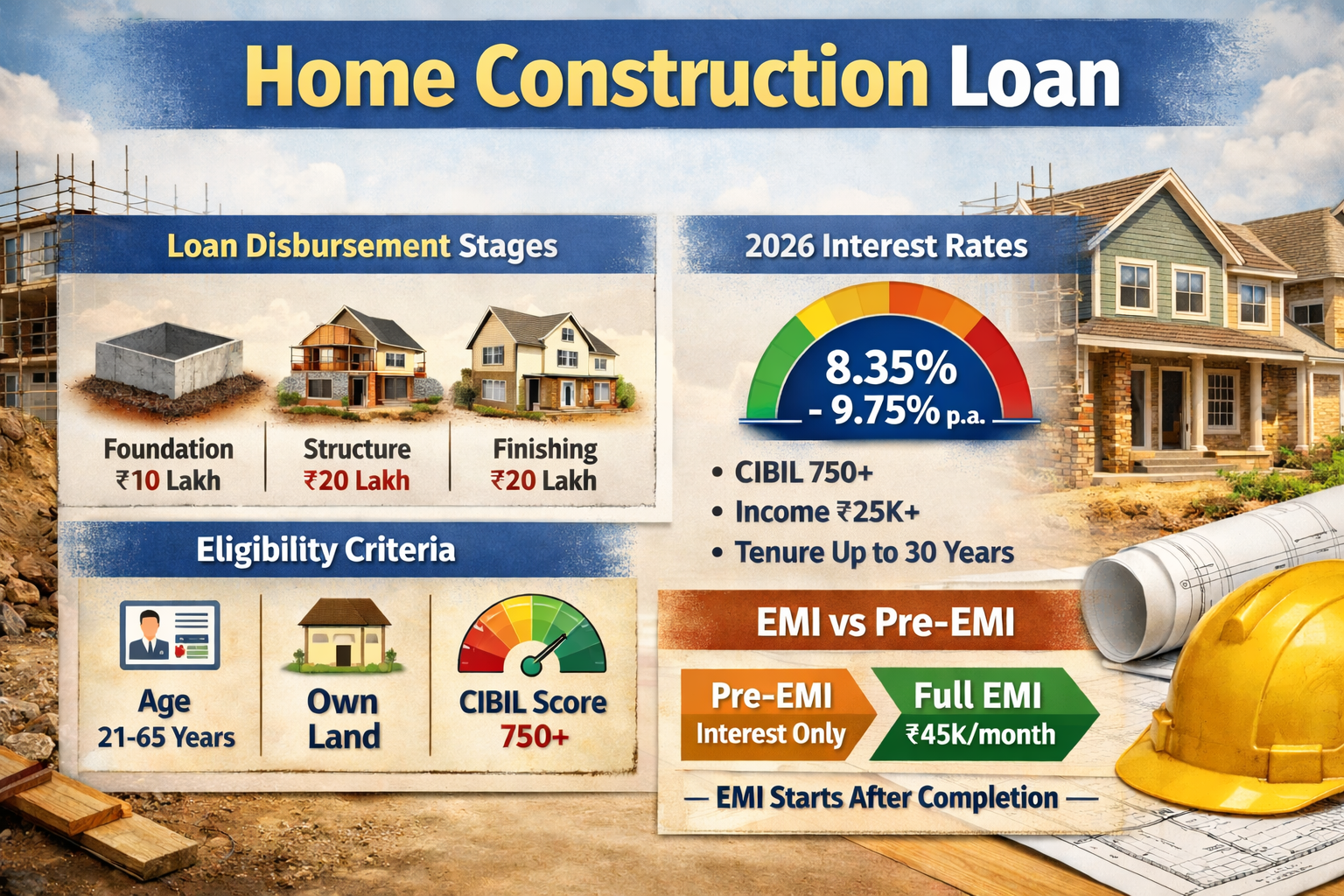
Let’s say you plan to build a house in Pune costing ₹50 lakh:
- Foundation stage → ₹10 lakh released
- Structure completion → ₹20 lakh
- Finishing → ₹20 lakh
Why banks do this
Banks reduce risk. If construction stops midway, they still have a partially built asset as security.
Key difference vs regular home loan
- No full disbursement at once
- Requires approved building plan
- Strict monitoring by bank engineers
If you’re planning to construct your own home, this loan is the only structured way to finance it.
How Home Construction Loan Works in India
Understanding how a home construction loan works can save you lakhs.
Step-by-step process
- Loan sanction based on your income & property
- Construction begins after approval
- Bank releases funds in stages
- Inspection by bank engineer before each disbursement
- You pay only interest initially (pre-EMI)
- Full EMI starts after completion
Real-life scenario
You take a ₹60 lakh loan:
- Month 1: ₹10 lakh released → interest only ₹7,500/month
- Month 6: ₹30 lakh released → interest increases
- Month 12: full amount → EMI starts (~₹52,000/month)
Why this matters
Many borrowers assume EMI starts immediately but during construction, you pay pre-EMI, which increases gradually.
This is where poor planning leads to financial stress.
Related: EMI calculator guide
Home Construction Loan Interest Rates in 2026
In 2026, interest rates are closely linked to RBI’s repo rate.
Typical home construction loan interest rates:
- 8.35% to 9.75% per annum
What affects your rate
- CIBIL score (750+) → lower rate
- Income stability → salaried vs self-employed
- Loan amount & tenure
- Location (metro vs tier-2)
Example
- Salary ₹1 lakh/month → rate ~8.5%
- Salary ₹60,000 → rate ~9.2%
Even a 0.5% difference can cost ₹6–8 lakh extra over 20 years.
Floating vs fixed rate
- Floating → linked to repo rate
- Fixed → higher but stable
You can track official repo changes via RBI: https://www.rbi.org.in
Home Construction Loan Eligibility Criteria India
This is where most applications get rejected.
Basic eligibility
- Age: 21 to 65 years
- Income: ₹25,000+ (minimum)
- CIBIL score: 750+ preferred
- Must own land (clear title)
How banks calculate loan amount
Banks use FOIR (Fixed Obligation to Income Ratio)
- Max EMI allowed: 40–50% of income
Example
- Salary: ₹80,000
- Existing EMI: ₹10,000
- Allowed EMI: ₹30,000
This directly affects your loan eligibility.
Self-employed borrowers
Need:
- 2–3 years ITR
- Business proof
- GST returns
Related: home loan eligibility calculator India
Documents Required for Home Construction Loan
Documentation is stricter than regular loans.
Personal documents
- Aadhaar, PAN
- Address proof
Income proof
- Salary slips / ITR (2–3 years)
- Bank statements (6–12 months)
Property & construction documents
- Land ownership papers
- Approved building plan
- Construction estimate from engineer
- NOC from local authority
Why banks need this
Banks verify if your construction is legal and financially viable.
Any missing document can delay approval by 7–15 days.
EMI Calculation & Pre-EMI Explained
This is the most misunderstood part.
Pre-EMI vs EMI
- Pre-EMI → interest only (during construction)
- Full EMI → after completion
Example
Loan: ₹50 lakh at 8.5%
- Year 1: Pre-EMI ~₹10,000–₹20,000
- After completion: EMI ~₹43,000
Hidden cost
Long construction = higher interest
If your project delays by 12 months, you may pay ₹2–4 lakh extra.
Pro tip
Choose faster builders or contractors to reduce interest burden.
Best Banks for Home Construction Loan (Comparison)
| Bank | Interest Rate (2026) | Max Tenure | Processing Fee | Special Feature |
|---|---|---|---|---|
| SBI | 8.40% | 30 years | 0.35% | Lowest rates, govt-backed |
| HDFC Bank | 8.75% | 25 years | 0.50% | Fast approval |
| ICICI Bank | 8.80% | 25 years | 0.50% | Flexible disbursement |
| Axis Bank | 8.90% | 25 years | 1% | Quick processing |
Example comparison
For ₹60 lakh loan:
- SBI EMI: ~₹51,800
- Axis EMI: ~₹53,500
Difference = ₹1,700/month → ₹4 lakh+ over tenure
Benefits of Home Construction Loan
1. Full design control
You build your dream home not a builder’s template.
2. Pay interest only on used funds
Reduces initial financial burden.
3. Lower cost vs ready property
Construction often costs 15–25% less.
4. Tax benefits
- Section 80C: ₹1.5 lakh
- Section 24: ₹2 lakh (after completion)
5. Flexible funding
Funds released as needed better cash flow control.
Common Mistakes to Avoid
1. Ignoring pre-EMI burden
Many borrowers think EMI starts later, but pre-EMI can strain monthly cash flow. Plan for it.
2. Starting construction without approval
Banks may reject disbursement if work starts early.
3. Underestimating construction cost
Costs often rise by 10–20%. Always keep buffer funds.
4. Choosing wrong contractor
Delays increase interest cost significantly.
5. Low CIBIL score application
Below 700 = higher rejection chances.
6. Not comparing lenders
Even small rate differences cost lakhs.
FAQs
1. What is a home construction loan and how is it different?
A home construction loan is used to build a house on your own land. Unlike regular home loans, funds are released in stages, and you pay pre-EMI during construction instead of full EMI.
2. Can I get a home construction loan without owning land?
Usually no. Most banks require you to already own the land. Some lenders offer combined plot + construction loans, but conditions are stricter.
3. How much loan can I get for construction?
Banks typically finance 75–90% of construction cost, depending on your income and eligibility.
4. Is interest higher for construction loans?
Yes, slightly higher than regular home loans usually by 0.2%–0.5%, due to higher risk.
5. How long does approval take?
Approval usually takes 7–15 working days, depending on documentation and property verification.
Conclusion
A home construction loan gives you the freedom to build your dream home but only if you understand how it works.
Key takeaways
- Stage-wise disbursement reduces risk but needs planning
- Pre-EMI can impact your monthly budget
- Interest rates vary compare before applying
- Proper documentation speeds up approval
- Delays can increase total cost significantly
If you’re planning to build your home, start by calculating your EMI and eligibility first.
Home Loan Eligibility Criteria India (2026 Guide)
SBI Home Loan Interest Rate 2026 – Latest Rates, EMI Impact, Eligibility & Full Guide