
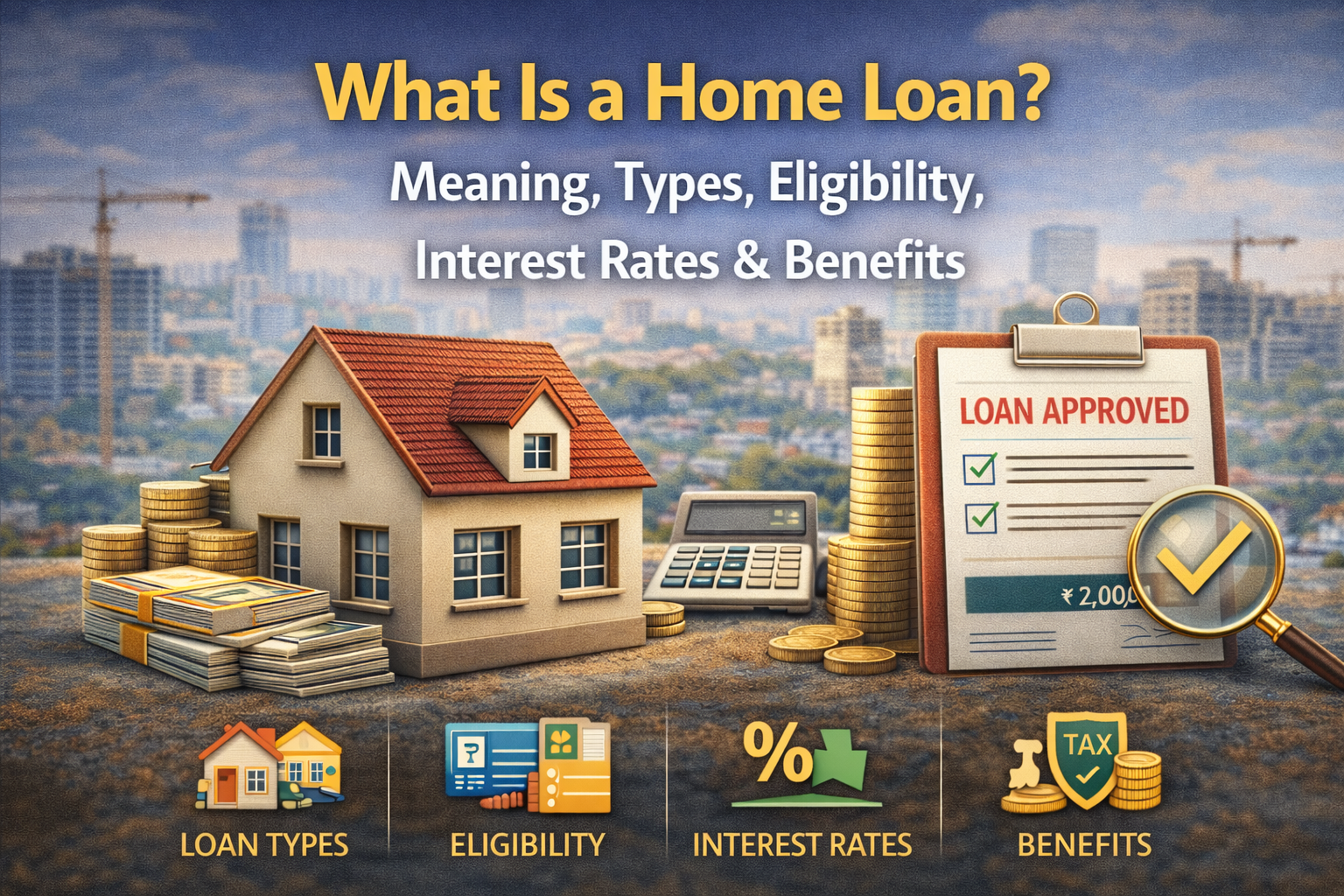
Buying a home is a major life milestone, but rising property prices make it difficult to purchase a house with savings alone. This is where a home loan plays a crucial role. A home loan helps individuals finance the purchase, construction, or improvement of a residential property by borrowing money from a bank or financial institution and repaying it over time.
In this guide, we explain what a home loan is, how it works, its types, eligibility criteria, interest rates, and key benefits, so you can make an informed decision.
Index
- What Is a Home Loan?
- How Does a Home Loan Work?
- Types of Home Loans Based on Purpose
- Types of Home Loans Based on Interest Rate
- Home Loan Eligibility Criteria in India
- Home Loan Interest Rates in India
- Benefits of Taking a Home Loan
- Fees and Charges in a Home Loan
- Important Home Loan Terminologies
- Documents Required for a Home Loan
- Using a Home Loan EMI Calculator
- How to Increase Home Loan Eligibility?
- FAQs: Home Loan Basics
- LoanNestHub Insight
What Is a Home Loan?
A home loan is a secured loan taken to buy, build, renovate, or extend a residential property. The property itself is kept as collateral with the lender until the loan is fully repaid.
Home loans are repaid through Equated Monthly Installments (EMIs) over a long tenure, usually ranging from 15 to 30 years. Once the loan is completely repaid, the lender releases the property title back to the borrower.
How Does a Home Loan Work?
Here’s how a typical home loan process works:
- Borrower applies for a home loan
- Lender checks eligibility, income, credit score, and property details
- Loan is sanctioned with defined terms
- Loan amount is disbursed (full or stage-wise)
- Borrower repays EMIs over the chosen tenure
For under-construction properties, loan disbursement usually happens in stages based on construction progress.
Types of Home Loans Based on Purpose
1. Home Purchase Loan
Used to buy a new or resale residential property.
2. Home Construction Loan
Designed for individuals who already own land and want to construct a house.
3. Home Renovation / Improvement Loan
Used for repairs, upgrades, or remodelling of an existing home.
4. Home Extension Loan
Suitable for adding rooms or expanding an existing residential structure.
5. Land Purchase Loan
Used to buy a residential plot for future construction.
6. Home Loan Balance Transfer
Allows borrowers to shift their existing loan to another lender offering lower interest rates or better terms.
7. Joint Home Loan
Taken with a spouse or family member to increase eligibility and share repayment responsibility.
8. Top-Up Home Loan
An additional loan taken over an existing home loan for extra funding needs.
Types of Home Loans Based on Interest Rate
Fixed-Rate Home Loan
The interest rate remains constant for a fixed period or entire tenure, offering EMI stability.
Floating-Rate Home Loan
The interest rate changes based on market conditions and RBI policy rates. EMIs may increase or decrease accordingly.
Hybrid Home Loan
A combination of fixed and floating rates fixed initially, then floating later.
Home Loan Eligibility Criteria in India
While eligibility varies by lender, common criteria include:
- Nationality: Indian resident
- Age:
- Salaried: up to 60–67 years at loan maturity
- Self-employed: up to 65–70 years at loan maturity
- Credit Score: Ideally 700+
- Employment: Salaried, professional, or self-employed
- Income stability & existing liabilities
Home Loan Interest Rates in India
Home loan interest rates in India generally range between 6.5% and 12%, depending on:
- RBI repo rate
- Applicant’s credit score
- Income stability
- Loan amount and tenure
- Type of interest rate (fixed or floating)
Floating-rate loans are linked to external benchmarks like the RBI repo rate and change over time.
Benefits of Taking a Home Loan
1. Own a Valuable Asset
Instead of paying rent, EMIs help you build ownership in a property that may appreciate over time.
2. Tax Benefits
Borrowers can claim tax deductions on:
- Interest paid on the loan
- Principal repayment, subject to income tax rules
3. Lower Interest Rates
Home loans offer lower interest rates compared to unsecured loans like personal loans.
4. Long Repayment Tenure
Extended tenures reduce monthly EMI burden and improve affordability.
5. Prepayment & Balance Transfer Options
Floating-rate home loans usually allow prepayment without penalty, helping reduce total interest.
6. Improves Credit Score
Regular EMI payments build a strong credit history.
7. Preserves Liquidity
You don’t need to exhaust your savings upfront, keeping emergency funds intact.
Fees and Charges in a Home Loan
Apart from interest, borrowers should be aware of:
- Processing fees
- Prepayment charges (mainly on fixed-rate loans)
- Foreclosure charges
- Legal and valuation fees
Always read the loan agreement carefully.
Important Home Loan Terminologies
- Down Payment: Buyer’s own contribution
- EMI: Monthly repayment amount
- Loan-to-Value (LTV): Percentage financed by lender
- Sanction Letter: Official loan approval document
- Disbursement: Release of loan amount
- Foreclosure: Closing the loan before tenure
Documents Required for a Home Loan
Commonly required documents include:
- Identity & address proof
- Income proof (salary slips / ITRs)
- Bank statements
- Property documents
- Sale agreement or allotment letter
Using a Home Loan EMI Calculator
A home loan EMI calculator helps you estimate monthly repayments based on loan amount, interest rate, and tenure. It allows better budgeting and easy comparison between loan options.
How to Increase Home Loan Eligibility?
- Improve credit score
- Reduce existing EMIs
- Apply with a co-applicant
- Choose a longer tenure
- Maintain stable income
FAQs: Home Loan Basics
What is a home loan in simple terms?
A loan taken to buy or build a home, repaid in monthly instalments.
Is home loan better than personal loan for property purchase?
Yes, due to lower interest rates and longer tenure.
Can I prepay a home loan?
Yes, most floating-rate home loans allow prepayment without penalty.
LoanNestHub Insight
A home loan is a long-term financial partnership, not just a loan. Choosing the right loan structure, interest type, and repayment plan can save lakhs over the loan tenure.