
You’re ready to apply for a home loan, but the moment you check the document list, it feels overwhelming and confusing. You’re not alone over 30 – 40% of home loan delays in India happen due to incomplete or incorrect documentation, as per banking industry estimates.
The problem is not eligibility. It’s paperwork. Banks like State Bank of India follow strict verification rules based on Reserve Bank of India guidelines, which means even small mismatches can delay approval or reduce your loan amount.
And the tricky part? Different documents are required depending on your income type, property type, and employment status.
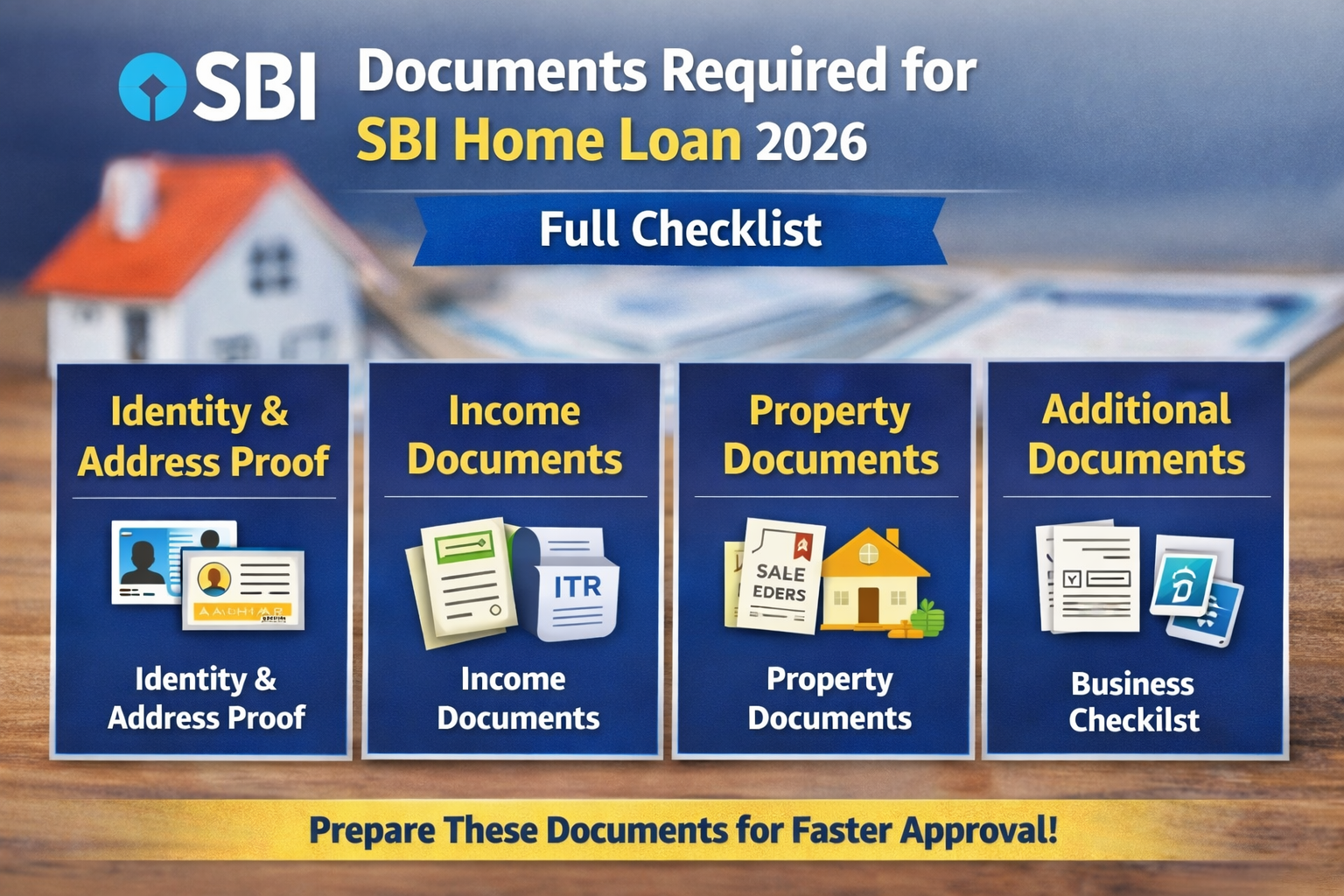
In this guide, you’ll learn the complete SBI home loan documents checklist for 2026, broken down clearly for salaried, self-employed, and property types with real examples, practical tips, and mistakes you must avoid.
Why SBI Home Loan Documents Matter
When you apply for an SBI home loan, the bank is not just giving you money it is taking a calculated financial risk. Documents help SBI answer three critical questions:
- Who are you? (KYC verification)
- Can you repay the loan? (income assessment)
- Is the property legally safe? (collateral verification)
Let’s understand this with a real example:
- Suppose you earn ₹75,000/month in Pune
- You apply for a ₹50 lakh home loan
- SBI will check:
- Your salary slips → income stability
- Your bank statement → actual salary credits
- Your ITR/Form 16 → tax compliance
- Your property papers → legal ownership
If even one document is missing (say, ITR), SBI may:
- Reduce your loan eligibility
- Delay approval by 5–10 working days
- Ask for additional verification
This is why preparing your SBI home loan documents in advance can save you time, stress, and even money.
How SBI Uses Your Documents
SBI follows a structured verification process aligned with RBI norms. Each document you submit fits into a specific check.
1. KYC Compliance (Mandatory by RBI)
SBI must verify your identity and address to prevent fraud and money laundering.
Example:
- Aadhaar + PAN mismatch → application put on hold
2. Credit Risk Assessment
SBI calculates your repayment ability using:
- Income documents
- Bank statements
- Existing EMIs
For example:
- Monthly income: ₹80,000
- Existing EMI: ₹20,000
- SBI may allow max EMI ~₹32,000 (40% FOIR rule)
3. Property Legal Verification
The property becomes SBI’s security. So they verify:
- Ownership chain
- Local approvals
- RERA registration (for new projects)
If the property has legal issues, SBI can reject the loan even if your income is strong.
Complete SBI Home Loan Documents Checklist
Let’s break down the SBI home loan documents into 5 key categories.
1. Identity & Address Proof
These documents confirm your identity and residence.
Accepted Identity Proof (Any One)
- Aadhaar Card
- PAN Card (mandatory)
- Passport
- Voter ID
Accepted Address Proof
- Aadhaar Card
- Passport
- Utility bill (last 2–3 months)
- Rent agreement
- Bank statement
Practical Example
If your Aadhaar shows Mumbai address but your bank statement shows Pune:
SBI may ask for address update proof
This can delay processing by 3 – 5 days
Pro Tip
Ensure:
- Name spelling is identical across documents
- Date of birth matches PAN & Aadhaar
2. Income Documents for Salaried Applicants
If you work in a company (private, PSU, or government), SBI focuses on income consistency.
Mandatory Documents
- Last 3 – 6 months salary slips
- Form 16 or ITR
- Last 6 months bank statement
Additional Documents
- Offer letter
- Increment letter
- Employment proof
Example (Real Scenario)
- Salary: ₹60,000/month
- Bonus not included in slips
SBI will consider only fixed salary, not variable bonuses, while calculating eligibility.
Why These Documents Matter
- Salary slips → current earning
- Bank statements → actual salary credited
- Form 16 → tax compliance
Without bank statements, SBI cannot confirm income authenticity.
3. Income Documents for Self-Employed Applicants
If you run a business or profession, documentation becomes more detailed.
Required Documents
- Last 2 – 3 years ITR
- Profit & Loss statement
- Balance sheet
- Business bank statements (6–12 months)
Business Proof
- GST registration
- Shop Act license
- Partnership deed / MOA / AOA
Example
- Business turnover: ₹40 lakh/year
- Net profit: ₹8 lakh/year
SBI considers net income (₹8 lakh), not turnover.
Key Insight
If your ITR shows low income, your loan eligibility drops even if actual cash flow is higher.
4. Property Documents Required for SBI Home Loan
This is the most critical part of SBI home loan documents.
A. Ready / Resale Property
- Sale Agreement
- Sale Deed
- Occupancy Certificate (OC)
- Approved building plan
- Chain of ownership
Example
Buying resale flat in Mumbai for ₹80 lakh:
SBI checks past ownership for last 10–15 years
Missing link → legal rejection
B. Under-Construction Property
- Builder-Buyer Agreement
- Project approval documents
- RERA registration
(Refer: Real Estate Regulatory Authority)
Example
If builder is not RERA registered:
SBI may refuse loan or delay approval
C. Plot + Construction Loan
- Plot sale deed
- Approved building plan
- Construction estimate
Why Property Documents Matter
SBI ensures:
- No legal disputes
- Clear ownership
- Approved construction
This reduces your risk of future litigation.
5. Additional Documents Required
These vary based on your case.
- Passport-size photographs
- Loan application form
- Processing fee receipt
- CIBIL consent form
- Power of Attorney (if applicable)
Documents Required by Applicant Type
| Applicant Type | Key Documents |
|---|---|
| Salaried | Salary slips, Form 16, bank statements |
| Self-employed | ITR, P&L, balance sheet |
| Joint applicants | Documents of all co-applicants |
| NRI applicants | Passport, visa, overseas income proof |
Example
If you apply jointly with spouse:
- Both incomes considered
- Both must submit full documents
This can increase eligibility from ₹40 lakh to ₹65 lakh.
SBI vs Other Banks Documentation Comparison
| Feature | SBI | Private Banks (HDFC, ICICI) |
|---|---|---|
| Documentation level | High | Moderate |
| Legal verification | Very strict | Moderate |
| Processing speed | 7–15 days | 3–7 days |
| Flexibility | Low | High |
| Risk level | Very low | Medium |
What This Means for You
- SBI = safer, slower
- Private banks = faster, slightly flexible
If you want maximum legal safety, SBI is better.
If you want quick approval, private banks may suit you.
Common Mistakes to Avoid
1. Name Mismatch Across Documents
Example:
- PAN: Rahul Sharma
- Aadhaar: Rahul Kumar Sharma
Leads to KYC delay
2. Not Filing ITR Properly
Especially for self-employed applicants.
Low declared income = low loan eligibility
3. Ignoring Property Legal Checks
Even if builder promises approvals:
Always verify documents independently
4. Submitting Old Bank Statements
SBI requires recent 6 months statements.
5. Not Checking CIBIL Before Applying
Even with perfect documents:
Low score (<700) can reduce approval chances
Expert Tips to Prepare SBI Home Loan Documents
- Keep both soft copies & originals ready
- Download ITR from income tax portal in advance
- Ensure salary credits match salary slips
- Verify property RERA status before booking
- Maintain consistent banking transactions
FAQs
1. What are the basic SBI home loan documents required?
You need identity proof, address proof, income documents, bank statements, and property papers.
2. Is PAN card compulsory for SBI home loan?
Yes, PAN card is mandatory for income verification and tax compliance.
3. How many years of ITR is required?
Salaried: 1- 2 years
Self-employed: 2 – 3 years mandatory
4. Does SBI ask for original documents?
Yes, SBI verifies originals but keeps only photocopies.
5. Can SBI reject loan due to property documents?
Yes. Even if your income is strong, property legal issues can lead to rejection.
Conclusion
The SBI home loan documents process may feel lengthy, but every document serves a purpose verifying your identity, income stability, and property safety.
If you prepare your documents in advance:
- Approval becomes faster
- Loan amount improves
- Stress reduces significantly
Before applying, take time to organise everything properly. It can easily save you 7–15 days of delay and improve your chances of approval.
Next step: Check your eligibility using our home loan eligibility calculator India and understand how much loan you can safely take before applying.