
You want to own a house in Haryana, but rising land prices and construction costs are making it impossible. Even a small 1BHK in cities like Gurugram or Faridabad can cost ₹20 – 40 lakh, which is out of reach for many families earning under ₹15,000 per month.
The reality is, according to government housing data, a large percentage of rural and low-income urban families still do not own a pucca house. And even when schemes exist, many applications get rejected due to incorrect Parivar Pehchan Patra (PPP) data or misunderstanding eligibility rules.
This makes the process confusing and frustrating. You might be eligible but a small mistake can cost you the benefit.
In this guide, you’ll learn everything about Mukhyamantri Awas Yojana Haryana 2026 including eligibility, benefits, real cost savings, PPP rules, and step-by-step application. By the end, you’ll know exactly how to apply correctly and improve your chances of approval.
What is Mukhyamantri Awas Yojana Haryana 2026
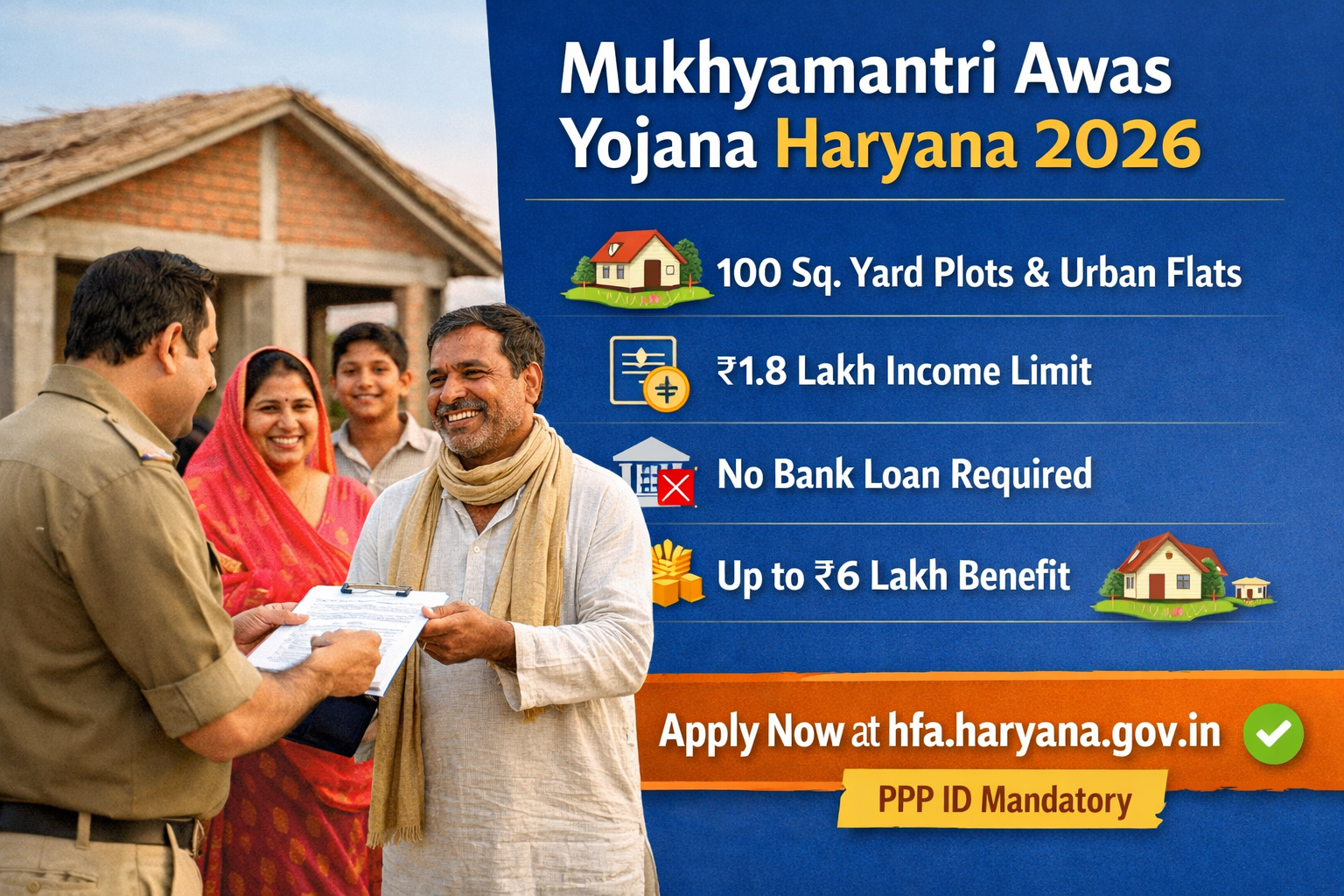
The Mukhyamantri Awas Yojana Haryana 2026 is a state government housing scheme aimed at providing affordable plots, flats, and financial support to low-income families.
Unlike private real estate projects where land alone can cost ₹5-10 lakh in villages and ₹20+ lakh in cities, this scheme directly reduces the biggest cost barrier land ownership.
Why this scheme matters
Housing affordability in India is not just about EMI. The real issue is:
- High land cost
- Lack of upfront savings
- Difficulty getting home loans for low-income families
This scheme solves all three problems:
- Provides free/subsidised land
- Offers financial assistance for construction
- Reduces need for bank loans
Example:
If you earn ₹1.5 lakh annually, no bank like SBI or HDFC will approve a large home loan due to low repayment capacity (FOIR limits). This scheme bypasses that problem by giving direct support.
Key Features and Benefits
1. Residential Plot Allocation
Under the scheme:
- 100 sq. yard plots in villages
- 50 sq. yard plots in semi-urban areas
Example:
In a village where land costs ₹4,000 per sq. yard, a 100 sq. yard plot is worth ₹4 lakh. You may get it free or at a very low price.
Why this matters:
Land is usually 40–60% of total property cost. Removing this makes home ownership possible.
2. Financial Assistance for House Construction
The government provides funds in instalments.
Typical structure:
- ₹40,000–₹60,000 initial
- Additional amount after construction progress
Example:
If your house construction costs ₹3 lakh, and you receive ₹1 lakh support, your out-of-pocket cost reduces by 33%.
3. PPP-Based Transparent System
Applications are linked to Parivar Pehchan Patra (PPP).
Why PPP is important:
- Income is verified digitally
- Reduces fraud
- Ensures genuine beneficiaries
Important:
If your PPP shows income above ₹1.8 lakh, your application will be rejected—even if your real income is lower.
4. No Need for Home Loan
Unlike many schemes, you don’t need a bank loan.
Example:
A person earning ₹10,000/month cannot get a loan due to FOIR (Fixed Obligation to Income Ratio). This scheme removes that barrier.
5. Priority to Vulnerable Groups
Preference is given to:
- SC/ST families
- Widows
- Nomadic communities
This ensures equitable housing distribution.
Gramin vs Shehri Scheme – Full Comparison
| Feature | Gramin Awas Yojana | Shehri Awas Yojana |
|---|---|---|
| Location | Villages | Cities |
| Benefit | 100 sq. yard plot | Flat or 50 sq. yard plot |
| Cost | Mostly free | ₹1–2 lakh approx. |
| Income limit | ₹1.8 lakh/year | ₹1.8 lakh/year |
| Loan needed | No | Optional |
| Selection | Survey-based | Draw system |
Example:
- If you live in a village in Hisar → you get land
- If you live in Gurugram → you may get a subsidised flat
Why difference exists:
Urban land is expensive, so flats are more practical. Rural areas allow land allocation.
Eligibility Criteria (Latest 2026 Rules)
To apply for Mukhyamantri Awas Yojana Haryana 2026, you must meet strict criteria.
Basic Eligibility
- Must be a Haryana resident
- Must have PPP (Family ID)
- Annual income ≤ ₹1.8 lakh
- Must not own a pucca house
Additional Conditions
- Should not have taken benefit under PMAY
- PPP data must match actual documents
- Urban applicants must not own property anywhere
Real-Life Scenario
You earn ₹12,000/month = ₹1.44 lakh/year → eligible
But if PPP shows ₹2 lakh → rejected
Solution:
Update PPP before applying
Why eligibility is strict
The government uses PPP to:
- Prevent duplicate benefits
- Target genuine low-income families
Documents Required
You need basic but accurate documents.
Mandatory
- PPP ID
- Aadhaar Card
- Income proof
- Residence proof
- Bank account
Supporting Documents
- Caste certificate
- BPL card
- Affidavit (no house ownership)
Practical Tip
Make sure:
- Name in Aadhaar = PPP
- Mobile linked to PPP
Otherwise, OTP verification fails.
How to Apply Online (Step-by-Step)
Step 1: Visit Official Portal
Go to hfa.haryana.gov.in
Step 2: Enter PPP ID
System fetches your family details
Step 3: OTP Verification
OTP sent to registered mobile
Step 4: Choose Scheme
- Rural (plot)
- Urban (flat/plot)
Step 5: Fill Details
- Income
- Category
- Preference
Step 6: Upload Documents
Step 7: Submit Application
Timeframe
- Application processing: 30-60 days
- Verification: 15-30 days
- Allotment (if selected): Depends on draw cycle
Selection Process Explained
1. Data Screening
PPP data used to shortlist applicants
2. Field Verification
Officials check:
- Housing condition
- Income proof
3. Final List
Eligible applicants shortlisted
4. Draw System (Urban)
Lottery used for fairness
Example (2026):
- 2,700+ families selected
- Flats priced around ₹1.5 lakh
Why lottery system?
Urban demand is high, supply is limited
Financial Benefits with Real Examples
Rural Example
- Plot value: ₹4 lakh
- Construction cost: ₹3 lakh
- Govt support: ₹1 lakh
Final cost: ₹2 lakh
Urban Example
- Flat cost: ₹1.5 lakh
- Market value: ₹6 lakh
Saving: ₹4.5 lakh
Why this matters
For low-income families:
- No need for ₹10–20 lakh loan
- No EMI burden
Mukhyamantri Awas Yojana vs PMAY
| Feature | Mukhyamantri Awas Yojana | PMAY |
|---|---|---|
| Coverage | Haryana | India |
| Benefit | Land + housing | Interest subsidy |
| Loan required | No | Yes |
| Target group | EWS/BPL | EWS, LIG, MIG |
| Max benefit | ₹4–6 lakh value | ₹2.67 lakh subsidy |
Insight:
- If you cannot take a loan → choose this scheme
- If you can → PMAY gives EMI benefit
PMAY eligibility and subsidy explained
Common Mistakes to Avoid
1. Wrong PPP Data
Most common rejection reason
2. Applying in Wrong Category
Urban vs rural mismatch
3. Not Checking Income Limit
Even ₹10,000 extra income → rejection
4. Missing Documents
Incomplete application = rejection
5. Ignoring Application Status
You may miss allotment updates
FAQs
1. How to apply for Mukhyamantri Awas Yojana Haryana 2026?
Apply online using PPP ID on the Haryana housing portal.
2. What is income limit for this scheme?
Maximum ₹1.8 lakh per year.
3. Can I apply without PPP?
No. PPP is mandatory.
4. Is loan required in this scheme?
No. It is not compulsory.
5. How much benefit will I get?
Up to ₹4–6 lakh worth of land or housing support.
Conclusion
The Mukhyamantri Awas Yojana Haryana 2026 is one of the most practical housing schemes for low-income families because it tackles the biggest challenge land ownership and upfront cost.
If your income is below ₹1.8 lakh and you don’t own a house, this scheme can reduce your total housing cost by ₹4–6 lakh, which is a massive financial relief.
However, your approval depends heavily on:
- Correct PPP data
- Proper documentation
- Applying in the right category
If you plan to build your house after getting a plot, you can also explore home construction loan guide India or estimate costs using home loan EMI calculator India.