
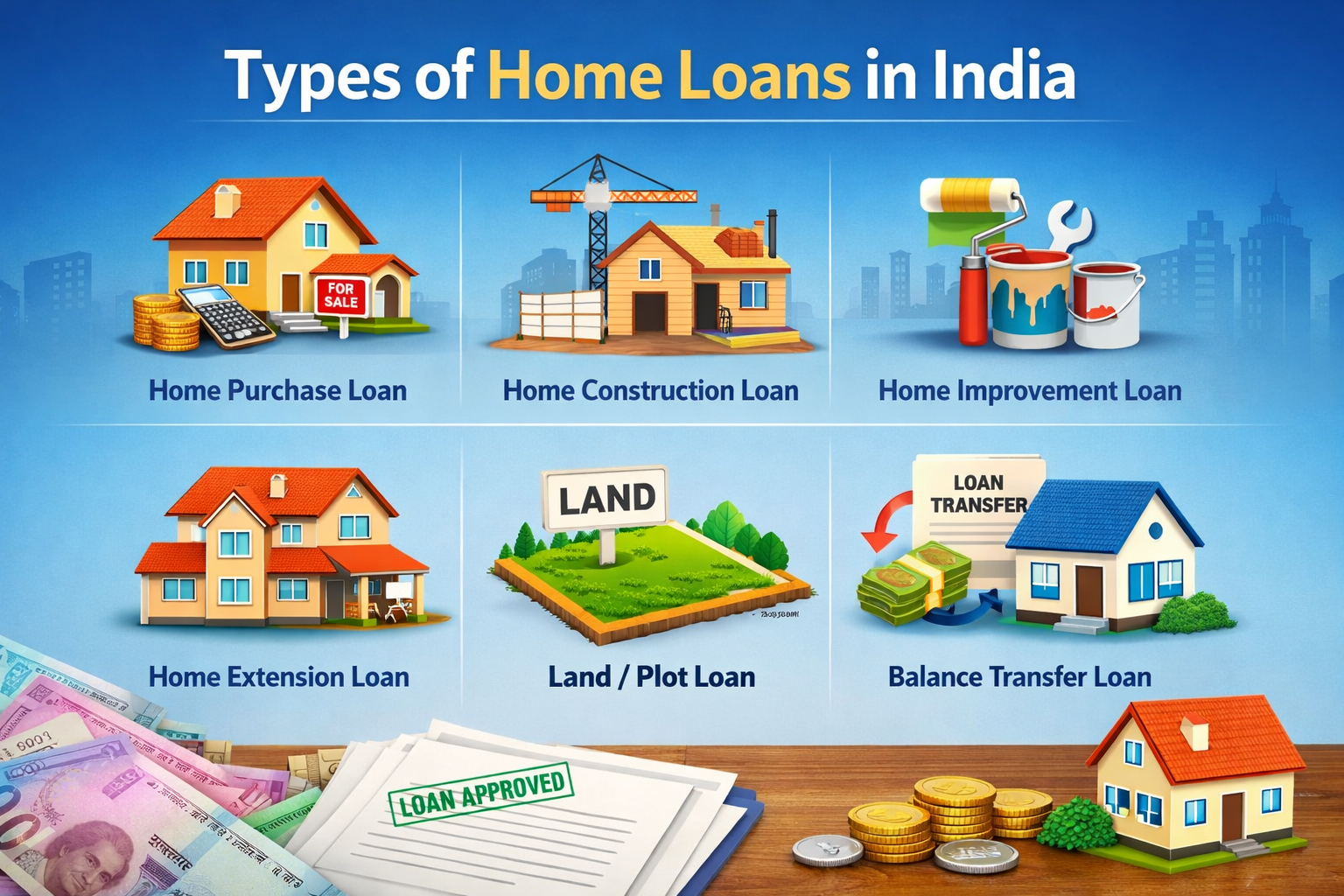
Buying a home is one of the most significant financial decisions you’ll make in your lifetime. Understanding the different types of home loans in India can help you choose the right financing option that matches your needs and financial situation. This comprehensive guide covers all major home loan types available in India, their features, eligibility criteria, and how to choose the best one for you.
What is a Home Loan?
A home loan is a secured loan provided by banks and financial institutions to help individuals purchase, construct, renovate, or extend their residential properties. The property itself serves as collateral, and borrowers repay the loan amount with interest over a predetermined period, typically ranging from 5 to 30 years.
10 Main Types of Home Loans in India
1. Home Purchase Loan
The most common type of home loan, a home purchase loan helps you buy a ready-to-move-in residential property, whether it’s an independent house, apartment, or flat.
Key Features:
- Loan amount: Up to 90% of the property value (LTV ratio)
- Tenure: 5 to 30 years
- Interest rates: 8.5% to 9.5% per annum (varies by lender)
- Tax benefits under Section 80C and Section 24(b)
Eligibility Criteria:
- Age: 21 to 65 years
- Minimum income: ₹25,000 per month (varies by location)
- Credit score: 750 or above preferred
- Employment: Stable income source (salaried or self-employed)
2. Home Construction Loan
If you own a plot of land and want to construct a house on it, a home construction loan provides funds in stages based on the construction progress.
Key Features:
- Disbursement in installments linked to construction milestones
- Requires approved building plans and construction estimates
- Interest charged only on disbursed amount
- Loan amount: Up to 80% of construction cost
Important Points:
- Construction must be completed within a specified timeframe (usually 2-3 years)
- Regular site inspections by the lender
- Requires clear land title in your name
3. Plot Loan or Land Purchase Loan
A plot loan helps you purchase a residential plot where you plan to construct a house in the future.
Key Features:
- Lower LTV ratio: 70-80% of plot value
- Higher interest rates compared to home purchase loans
- Shorter tenure: Up to 15 years typically
- The plot must be in an approved residential area
Eligibility Requirements:
- Plot must be residential and RERA-approved
- Clear title documentation required
- Some lenders may require construction plans
4. Home Extension Loan
If you want to add extra rooms, a floor, or expand your existing property, a home extension loan provides the necessary funds.
Key Features:
- Loan amount based on construction cost and property value
- Requires approved extension plans
- Can be availed against existing property
- Interest rates similar to home construction loans
Documents Required:
- Property ownership papers
- Approved building extension plans
- Cost estimates from contractors
5. Home Improvement Loan or Home Renovation Loan
This loan helps you renovate, repair, or upgrade your existing home without using your savings.
Key Features:
- Lower loan amounts: ₹2 lakhs to ₹50 lakhs
- Shorter tenure: 5 to 15 years
- Faster processing and approval
- Minimal documentation compared to other home loans
Common Uses:
- Interior renovations
- Roof repairs
- Plumbing and electrical upgrades
- Painting and flooring
- Kitchen and bathroom remodeling
6. Home Conversion Loan or Balance Transfer
A home conversion loan allows you to transfer your existing home loan from one lender to another to get better interest rates or terms.
Benefits:
- Lower interest rates
- Reduced EMI burden
- Top-up loan facility
- Better customer service
Things to Consider:
- Processing fees and charges
- Prepayment penalties from existing lender
- Break-even analysis before switching
- Lock-in period clauses
7. Bridging Loan or Bridge Loan
A bridge loan is a short-term loan that helps you purchase a new property before selling your existing one.
Key Features:
- Short tenure: 6 months to 2 years
- Higher interest rates
- Quick approval process
- Loan amount up to 80% of property value
Ideal For:
- Those upgrading to a larger home
- Investors managing multiple properties
- Temporary financial gaps
8. Home Loan Top-Up or Additional Home Loan
Once you’ve repaid a portion of your existing home loan, you can avail a top-up loan for personal or professional needs.
Key Features:
- Based on your repayment track record
- Lower interest rates than personal loans
- Flexible end-use (education, wedding, business, medical)
- Longer repayment tenure
Eligibility:
- Must have an existing home loan
- Good repayment history
- Sufficient equity in the property
9. NRI Home Loan
Non-Resident Indians can avail home loans to purchase residential property in India.
Key Features:
- Similar interest rates as resident Indians
- Loan amount up to 80% of property value
- Repayment in foreign currency allowed
- Property can be self-occupied or rented out
Special Requirements:
- Valid passport and visa
- Overseas employment proof
- NRE/NRO bank account in India
- Power of attorney (if required)
10. Joint Home Loan
A joint home loan is taken by two or more co-applicants, typically family members, to increase the loan eligibility amount.
Advantages:
- Higher loan eligibility due to combined income
- Tax benefits for all co-borrowers
- Shared repayment responsibility
- Better chances of approval
Common Co-Applicants:
- Spouse
- Parents
- Children
- Siblings (in some cases)
Types of Interest Rates on Home Loans
Fixed Interest Rate Home Loan
The interest rate remains constant throughout the loan tenure, ensuring fixed EMI payments.
Pros:
- EMI predictability
- Protection from rate fluctuations
- Better financial planning
Cons:
- Generally higher than floating rates
- No benefit if market rates decrease
Floating Interest Rate Home Loan
The interest rate fluctuates based on market conditions and the lender’s MCLR (Marginal Cost of Funds Based Lending Rate).
Pros:
- Lower initial interest rates
- Benefit from rate reductions
- More popular in India
Cons:
- EMI uncertainty
- Can increase significantly during rate hikes
Hybrid or Mixed Interest Rate
Combines both fixed and floating rates, where the loan starts with a fixed rate for an initial period and then switches to a floating rate.
Best For:
- First-time homebuyers seeking initial stability
- Those expecting future income growth
How to Choose the Right Home Loan Type
Consider these factors when selecting a home loan:
- Purpose: Define whether you’re purchasing, constructing, renovating, or extending
- Financial situation: Assess your income, savings, and existing liabilities
- Interest rates: Compare rates across multiple lenders
- Loan tenure: Balance between affordable EMI and total interest outgo
- Processing fees and charges: Hidden costs can significantly impact total cost
- Prepayment flexibility: Check for prepayment penalties
- Tax benefits: Maximize deductions under Income Tax Act
Tax Benefits on Home Loans in India
Home loan borrowers can claim significant tax deductions:
Section 80C: Deduction up to ₹1.5 lakhs on principal repayment
Section 24(b): Deduction up to ₹2 lakhs on interest payment for self-occupied property
Section 80EEA: Additional ₹1.5 lakhs deduction on interest for first-time homebuyers (affordable housing)
Total potential tax benefit: Up to ₹5 lakhs per financial year
Documents Required for Home Loan Application
Identity Proof:
- PAN Card
- Aadhaar Card
- Passport
- Voter ID
Address Proof:
- Utility bills
- Aadhaar Card
- Passport
- Rent agreement
Income Proof:
- Salary slips (last 3-6 months)
- Form 16
- ITR for last 2-3 years
- Bank statements (last 6 months)
Property Documents:
- Sale agreement
- Property papers
- Approved building plans
- Encumbrance certificate
- NOC from builder/society
Home Loan Eligibility Factors
Lenders evaluate these criteria:
- Age: 21-65 years (varies by lender)
- Income: Minimum monthly income requirement
- Credit score: 750+ for better rates
- Employment stability: At least 2 years of work experience
- Existing liabilities: Debt-to-income ratio below 40-50%
- Property value: Must meet lender’s valuation standards
Top Banks Offering Home Loans in India 2026
- State Bank of India (SBI)
- HDFC Bank
- ICICI Bank
- LIC Housing Finance
- Bajaj Housing Finance
- Bank of Baroda
- Punjab National Bank (PNB)
- Axis Bank
- Kotak Mahindra Bank
- DHFL (if operational)
Tips for Getting the Best Home Loan Deal
- Improve your credit score: Pay existing debts on time and maintain low credit utilization
- Compare multiple lenders: Don’t settle for the first offer
- Negotiate interest rates: Your profile might qualify for better rates
- Increase down payment: Higher down payment means lower loan amount and interest
- Choose appropriate tenure: Balance between EMI affordability and total interest cost
- Read fine print: Understand all terms, conditions, and hidden charges
- Opt for pre-approved loans: Faster processing and better negotiation power
- Consider employer tie-ups: Many companies have special arrangements with banks
Common Mistakes to Avoid
- Not checking credit score before applying
- Overlooking hidden charges and processing fees
- Choosing the longest tenure without calculation
- Ignoring prepayment flexibility
- Not comparing offers from multiple lenders
- Providing incomplete or incorrect documentation
- Ignoring property verification and legal checks
- Not understanding the fine print in loan agreement
Frequently Asked Questions (FAQs)
Q1: What is the maximum home loan amount I can get?
Most banks offer up to 90% of the property value, though the exact amount depends on your income, credit score, and property location. Some lenders may finance up to ₹5 crores or more for eligible borrowers.
Q2: Can I prepay my home loan?
Yes, most banks allow prepayment. For floating rate loans, there’s typically no prepayment penalty. Fixed-rate loans may have prepayment charges of 2-3% of the outstanding amount.
Q3: What is the ideal loan tenure?
While 15-20 years is common, the ideal tenure depends on your age, income, and financial goals. Shorter tenures mean higher EMIs but lower total interest, while longer tenures offer lower EMIs but higher total cost.
Q4: Can I get a home loan with a low credit score?
A score below 700 makes approval difficult. Scores between 700-750 may get approval but at higher interest rates. A score above 750 significantly improves your chances and gets you better rates.
Q5: Is home insurance mandatory?
Most lenders make home insurance mandatory to protect their investment. It covers the property against natural calamities, fire, and other risks.
Q6: How long does home loan approval take?
With complete documentation, approval can take 7-15 working days. Pre-approved loans are faster, sometimes within 48-72 hours.
Q7: Can I transfer my home loan to another person?
Direct loan transfer isn’t allowed, but the property can be transferred through sale and the new owner can take a fresh loan.
Q8: What happens if I can’t pay my home loan EMI?
Missing EMIs damages your credit score and can lead to penalties, legal action, and ultimately property auction by the lender. Contact your bank immediately if facing repayment difficulties to explore restructuring options.
Conclusion
Choosing the right type of home loan in India requires careful consideration of your financial situation, property requirements, and long-term goals. Whether you’re a first-time homebuyer opting for a home purchase loan, an NRI investing in Indian property, or someone looking to renovate an existing home, there’s a suitable loan product available.
Research thoroughly, compare offers from multiple lenders, understand all terms and conditions, and choose a loan that offers the best combination of interest rates, flexibility, and customer service. With home loans being one of the largest financial commitments you’ll make, taking time to make an informed decision will save you lakhs of rupees over the loan tenure.
Remember to leverage available tax benefits, maintain a good credit score, and choose a repayment strategy that aligns with your financial capacity. The dream of owning a home in India is achievable with the right home loan supporting your journey.
Disclaimer: Interest rates, loan terms, and policies mentioned in this article are indicative and subject to change. Please verify current rates and terms with respective lenders before making any decisions.