
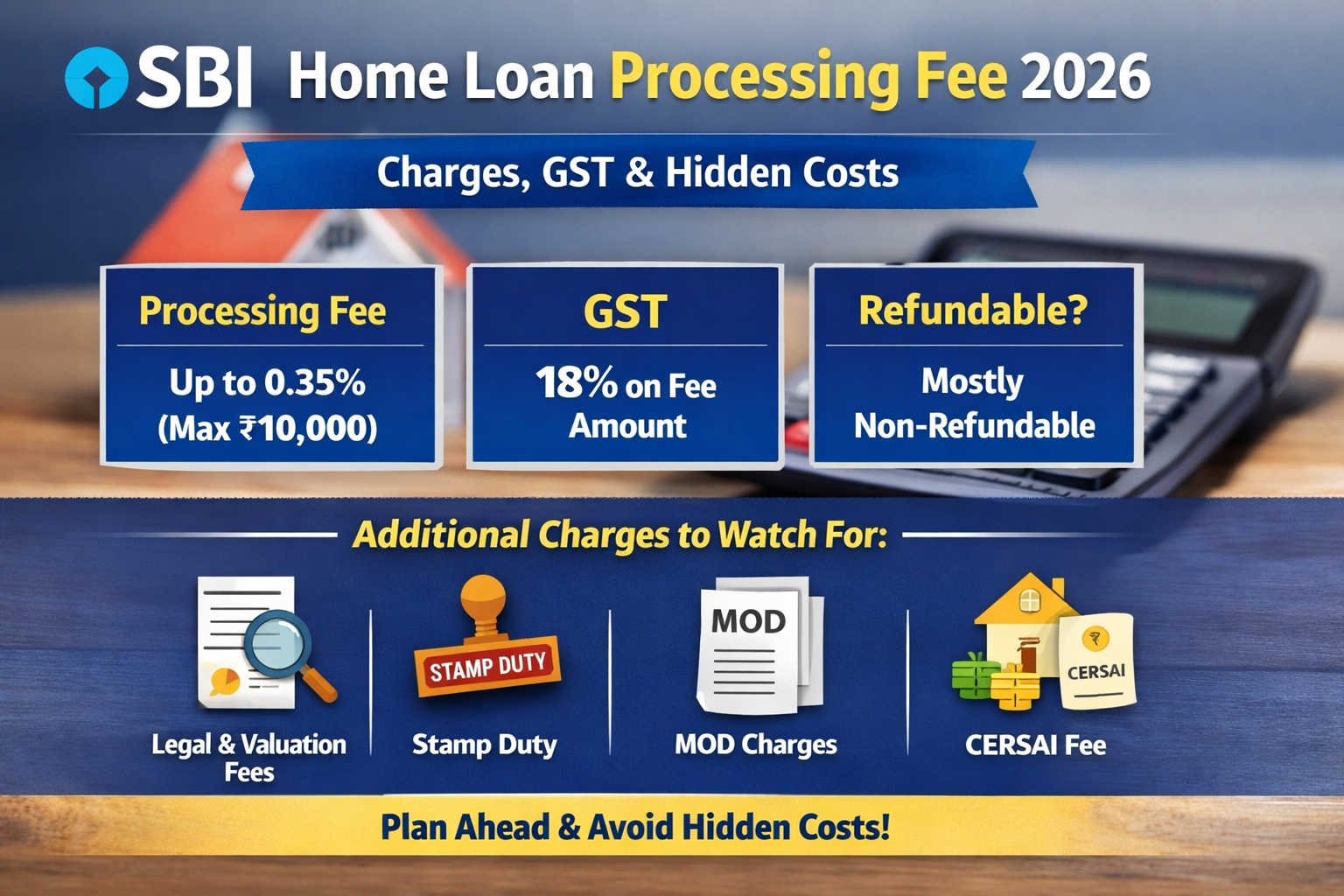
You’re planning to take a home loan from State Bank of India, but you’re confused about how much you’ll actually pay upfront beyond the EMI.
That confusion is valid. Many Indian borrowers focus only on interest rates, while ignoring charges like processing fees, GST, and legal costs which can easily add ₹15,000 – ₹30,000 extra to your initial expense.
The problem? Banks don’t always present the full cost clearly. Processing fees look small, but combined with GST and additional charges, they can stretch your budget especially when you’re already arranging down payment, registration, and interiors.
In this guide, you’ll understand the exact SBI Home Loan Processing Fee in 2026, including GST, refund rules, hidden charges, comparison with other banks, and practical ways to reduce your cost.
What Is SBI Home Loan Processing Fee?
When you apply for a home loan, SBI doesn’t just approve it instantly. Your application goes through multiple steps and that’s exactly what the processing fee covers.
This one-time fee is charged for:
- Credit assessment based on your income and CIBIL score
- Property legal verification
- Technical valuation (property inspection)
- Administrative and documentation costs
Why does SBI charge this fee?
Banks like State Bank of India must follow strict lending norms set by the Reserve Bank of India. Every loan file undergoes risk checks. Even if your loan is rejected, the bank still incurs these costs.
Real Example
Let’s say you apply for a ₹50 lakh home loan in Pune:
- SBI evaluates your salary, existing EMIs, and credit history
- Sends a legal officer to verify property documents
- Conducts site inspection for valuation
All of this happens before final approval and the processing fee covers these efforts.
Important: This fee is not part of your EMI. It’s paid upfront.
SBI Home Loan Processing Fee 2026 (Latest Structure)
As of 2026, SBI continues to offer one of the most affordable fee structures among Indian lenders.
Standard Charges
| Loan Type | Processing Fee |
|---|---|
| Regular SBI Home Loan | Up to 0.35% of loan amount |
| Maximum Cap | ₹10,000 (excluding GST) |
Key Insight
The cap of ₹10,000 is what makes SBI attractive – especially for high-value loans.
Real Examples
Example 1: ₹30 lakh loan
- 0.35% = ₹10,500
- But due to cap → You pay ₹10,000 only
Example 2: ₹15 lakh loan
- 0.35% = ₹5,250
- You pay ₹5,250
Example 3: ₹80 lakh loan
- 0.35% = ₹28,000
- But capped → You pay ₹10,000 only
Why this matters
Private banks often charge 1% or more without strict caps, meaning you could pay ₹50,000–₹80,000 for large loans.
SBI’s capped structure directly saves you money.
GST on SBI Processing Fee
Processing fees are not the final amount you pay. GST applies on top of it.
GST Rate
- 18% GST applicable
- Charged only on the processing fee (not loan amount)
Example Calculation
- Processing Fee: ₹10,000
- GST @18%: ₹1,800
- Total Payable: ₹11,800
Important Clarification
- GST is governed by Government tax laws
- It is non-refundable
- Even if your loan is rejected, GST is not returned
Why borrowers miss this
Many borrowers assume ₹10,000 is the total cost – but the actual payment is always higher due to GST.
Always ask for “all-inclusive amount” before paying.
Is SBI Processing Fee Refundable?
In most cases, NO – the processing fee is non-refundable.
When do you lose the fee?
You may not get your money back if:
- You withdraw your application after submission
- Your loan is rejected due to low eligibility
- Property fails legal or technical verification
Why is it non-refundable?
Because the bank has already completed:
- Background checks
- Property inspection
- Documentation work
These processes incur real costs – regardless of loan approval.
Real Scenario
You apply for a ₹40 lakh loan but:
- Your FOIR exceeds acceptable limit
- Property has legal dispute
Result: Loan rejected → Processing fee lost
This is why checking eligibility before applying is critical.
home loan eligibility calculator India
Hidden Charges in SBI Home Loan
SBI is transparent compared to many lenders, but there are still additional costs you must budget for.
1. Legal & Technical Charges
- Charged separately from processing fee
- Covers property verification and valuation
Example:
- ₹3,000 – ₹8,000 depending on city
2. MOD Charges (Mortgage Registration)
Applicable in states like Maharashtra
- Around 0.2% – 0.3% of loan amount
Example (₹50 lakh loan):
- ₹10,000 – ₹15,000
3. Stamp Duty on Loan Agreement
Varies by state
- Usually 0.1% – 0.2% of loan amount
4. CERSAI Charges
- Government registration fee
- Around ₹50 – ₹500
5. EMI Bounce Charges
If your EMI fails
- ₹500 – ₹1,000 + GST
Total Real Cost Example
For ₹50 lakh loan in Mumbai:
| Component | Cost |
|---|---|
| Processing Fee | ₹10,000 |
| GST | ₹1,800 |
| Legal/Technical | ₹5,000 |
| MOD Charges | ₹12,000 |
| Total Extra Cost | ₹28,800 |
This is why understanding full cost is essential – not just processing fee.
Does SBI Offer Zero Processing Fee?
Yes, but only during specific campaigns.
When does SBI waive fees?
- Festive seasons (Diwali, New Year)
- Special housing schemes
- Online-only loan applications
What’s actually waived?
- Processing fee → Often waived
- GST → Sometimes still applicable
- Legal charges → Usually NOT waived
Real Example
During festive offer:
- Processing Fee: ₹0
- GST: ₹0 or applicable
- Legal charges: ₹4,000–₹6,000
Important Tip
Always ask for written confirmation from SBI branch or website.
Many borrowers assume “zero cost” but still pay thousands in other charges.
SBI vs Other Banks: Processing Fee Comparison
Here’s how SBI compares with other lenders in India:
| Bank Type | Processing Fee |
|---|---|
| SBI | Up to 0.35% (Cap ₹10,000) |
| PSU Banks | 0.25% – 0.50% |
| Private Banks | 0.50% – 1.00% |
| NBFCs | 1% – 2% |
Real Comparison
For ₹60 lakh loan:
- SBI → ₹10,000
- Private Bank (1%) → ₹60,000
- NBFC (1.5%) → ₹90,000
SBI saves you ₹50,000–₹80,000 upfront
Why SBI is cheaper
- Government-backed institution
- Focus on affordability
- Lower operational margins
Impact on Your Total Cost
Processing fee may seem small, but it directly affects your cash flow at purchase time.
Short-Term Impact
You need extra funds for:
- Down payment (10–25%)
- Stamp duty (5–7%)
- Registration
- Interiors
Adding ₹20,000 – ₹30,000 more can strain your budget.
Long-Term Impact
- Doesn’t affect EMI
- But increases total cost of borrowing
Real Scenario
Buying ₹80 lakh property:
- Down payment: ₹16 lakh
- Registration: ₹5 lakh
- Loan charges: ₹25,000
Total upfront → ₹21.25 lakh
That extra ₹25,000 still matters.
Expert Tips to Reduce Processing Costs
1. Apply During SBI Offers
Festive discounts can save ₹10,000+
2. Improve Your CIBIL Score
Higher score → faster approval → less risk of rejection
3. Pre-check Eligibility
Avoid losing fees due to rejection
[link: how banks calculate home loan eligibility India]
4. Compare Total Cost, Not Just Interest
Low interest + high fees = expensive loan
5. Negotiate (Yes, It’s Possible)
For high-value loans (₹75 lakh+), banks may:
- Reduce fee
- Offer waivers
FAQs
1. What is SBI home loan processing fee in 2026?
It is up to 0.35% of loan amount, capped at ₹10,000 (excluding GST).
2. Is GST charged on SBI processing fee?
Yes, 18% GST is added on the processing fee.
3. Can SBI waive processing fee?
Yes, during festive or promotional offers.
4. Is processing fee refundable if loan is rejected?
No, it is usually non-refundable once processing starts.
5. Are legal charges included in processing fee?
No, legal and technical charges are separate.
Conclusion
SBI Home Loan Processing Fee in 2026 remains one of the lowest in India thanks to its 0.35% structure and ₹10,000 cap. For most borrowers, this translates into significant savings compared to private banks and NBFCs.
But you shouldn’t stop at just this number. GST, legal charges, and state-specific costs can increase your upfront expense by ₹20,000 or more.
If you plan smartly check eligibility, apply during offers, and understand the full cost you can avoid unnecessary expenses and make better financial decisions.
👉 Before applying, use our tools:
These will help you plan your loan accurately and avoid surprises.