
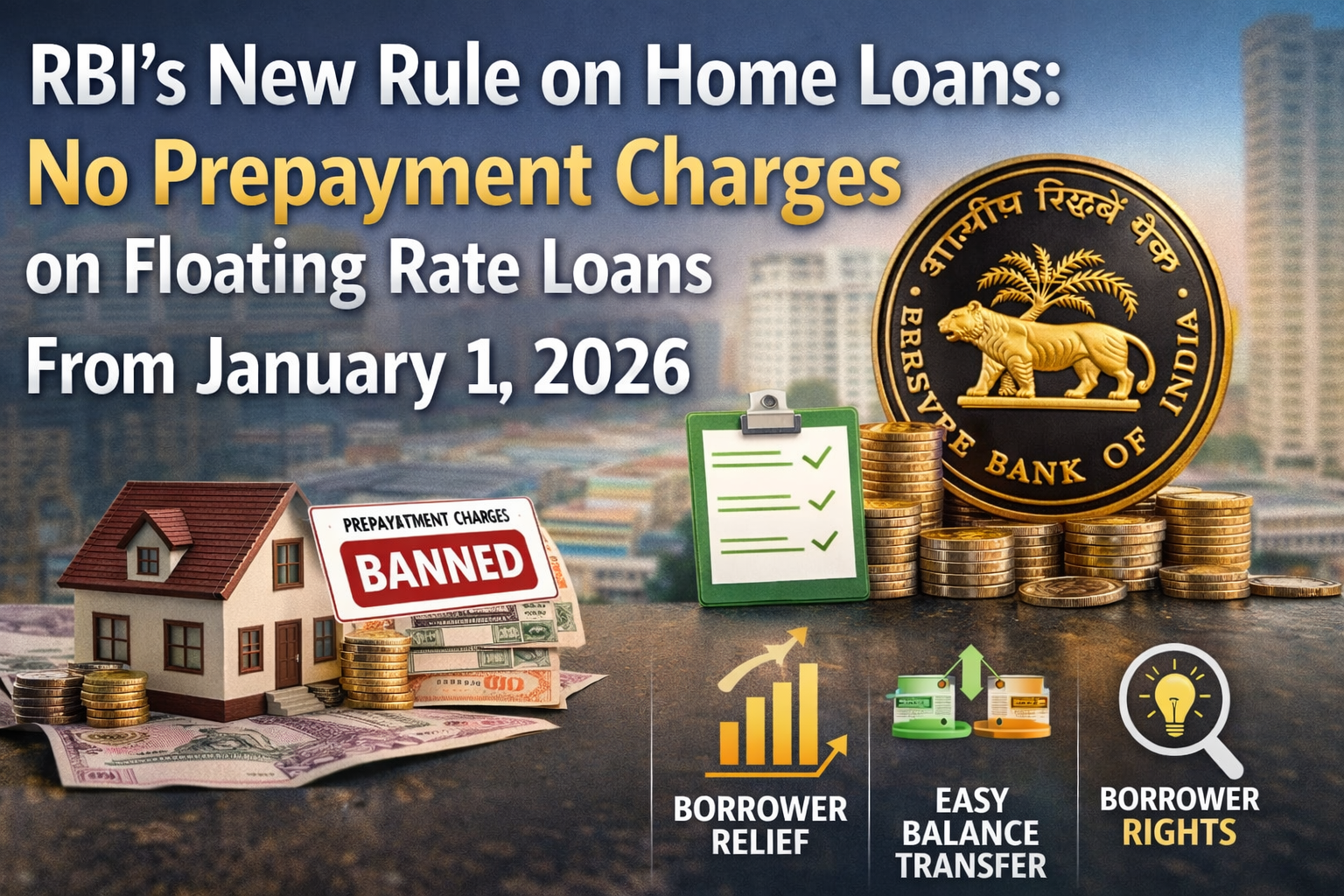
In a major relief for home loan borrowers, the Reserve Bank of India (RBI) has announced that no prepayment or foreclosure charges can be levied on floating-rate home loans starting January 1, 2026. The move is aimed at improving transparency, reducing borrower grievances, and allowing customers to switch lenders freely for better interest rates and service.
This change will significantly impact both existing and new floating-rate home loan borrowers, especially those planning prepayments, balance transfers, or early loan closures.
Index
- What Is RBI’s New Prepayment Rule?
- Which Home Loan Borrowers Will Benefit?
- Applicability Based on Loan Purpose
- Which Lenders Are Covered – and Which Are Excluded?
- Why Did RBI Introduce This Rule?
- What About Fixed-Rate Home Loans?
- Rules for Cash Credit and Overdraft Facilities
- What If the Lender Initiates the Prepayment?
- Mandatory Disclosure in Loan Documents
- What This Means for Home Loan Borrowers
- FAQs: RBI Prepayment Rule on Home Loans
What Is RBI’s New Prepayment Rule?
Under the Reserve Bank of India (Pre-payment Charges on Loans) Directions, 2025, the RBI has instructed banks and other regulated entities (REs) to stop charging prepayment penalties on eligible floating-rate loans.
Key Highlights:
- No prepayment charges on floating-rate loans granted to individuals
- Applicable to full or partial prepayment
- No minimum lock-in period
- Applies regardless of the source of funds used for prepayment
- Effective for loans sanctioned or renewed on or after January 1, 2026
Which Home Loan Borrowers Will Benefit?
This rule primarily benefits borrowers with floating-rate home loans, which now form the majority of housing loans in India.
Beneficiaries include:
- Individual home loan borrowers
- Joint home loan holders
- Borrowers planning partial prepayments
- Borrowers looking to switch lenders via balance transfer
- Micro & Small Enterprise (MSE) borrowers with floating-rate loans
In short, anyone with a qualifying floating-rate loan stands to gain.
Applicability Based on Loan Purpose
Loans for Non-Business Purposes
For individuals (with or without co-borrowers):
- No prepayment charges allowed
- Applies to all floating-rate loans
Business Loans to Individuals & MSEs
- Commercial banks cannot levy prepayment charges
- Certain institutions are excluded (explained below)
Which Lenders Are Covered – and Which Are Excluded?
Fully Covered (No Charges Allowed)
- Scheduled commercial banks
- Most large public & private sector banks
Partial / Conditional Coverage
For loans up to ₹50 lakh, no prepayment charges can be levied by:
- Small Finance Banks
- Regional Rural Banks
- Tier-3 Primary (Urban) Co-operative Banks
- State & Central Co-operative Banks
- NBFC-MLs
Excluded Institutions (Certain Cases)
- Small Finance Banks (for higher loan amounts)
- Regional Rural Banks (for higher limits)
- Tier-4 Urban Co-operative Banks
- NBFC-ULs
- All India Financial Institutions
Why Did RBI Introduce This Rule?
The RBI observed that lenders were following inconsistent and sometimes restrictive practices regarding prepayment charges.
According to the central bank:
- Borrowers faced confusion due to non-uniform rules
- Some lenders used foreclosure charges to discourage balance transfers
- Restrictive clauses limited borrower choice and competition
By removing these charges, RBI aims to:
- Reduce customer complaints
- Encourage fair competition
- Improve transparency in loan agreements
- Empower borrowers to refinance freely
What About Fixed-Rate Home Loans?
The new rule does not eliminate prepayment charges on fixed-rate loans.
However, RBI has placed limits:
- Charges, if applicable, must be calculated only on the prepaid amount
- No hidden or retrospective charges allowed
- Terms must be clearly disclosed upfront
Rules for Cash Credit and Overdraft Facilities
For cash credit or overdraft loans:
- No prepayment charges if the borrower informs the lender in advance
- Facility must be closed on the agreed due date
- Charges cannot exceed the sanctioned limit
What If the Lender Initiates the Prepayment?
If prepayment happens at the lender’s request or initiative, then:
- No charges can be levied
- Charges waived earlier cannot be reintroduced at the time of closure
Mandatory Disclosure in Loan Documents
The RBI has made disclosure rules stricter.
Lenders must clearly mention:
- Applicability of prepayment charges
- Conditions under which charges apply
- Details in the Sanction Letter
- Details in the Loan Agreement
- Clear mention in the Key Facts Statement (KFS)
If a charge is not mentioned in the KFS, it cannot be levied later.
What This Means for Home Loan Borrowers
- Floating-rate borrowers gain full flexibility
- Balance transfers become easier and cheaper
- Prepayment planning becomes more effective
- Borrowers can reduce total interest without penalty
- Lenders will need to compete more on rates and service
This rule strengthens borrower rights and makes the home loan ecosystem more transparent and borrower-friendly.
FAQs: RBI Prepayment Rule on Home Loans
From when is the RBI rule effective?
From January 1, 2026, for loans sanctioned or renewed on or after that date.
Does this apply to existing home loans?
Only if the loan is renewed or newly sanctioned after January 1, 2026.
Are partial prepayments also free of charges?
Yes, for eligible floating-rate loans.
Does this apply to NBFC home loans?
Yes, but with certain limits and exclusions depending on the NBFC category.
Can banks still charge prepayment fees if mentioned in agreement?
No, if the RBI directions prohibit it – even contractual clauses cannot override RBI rules.