
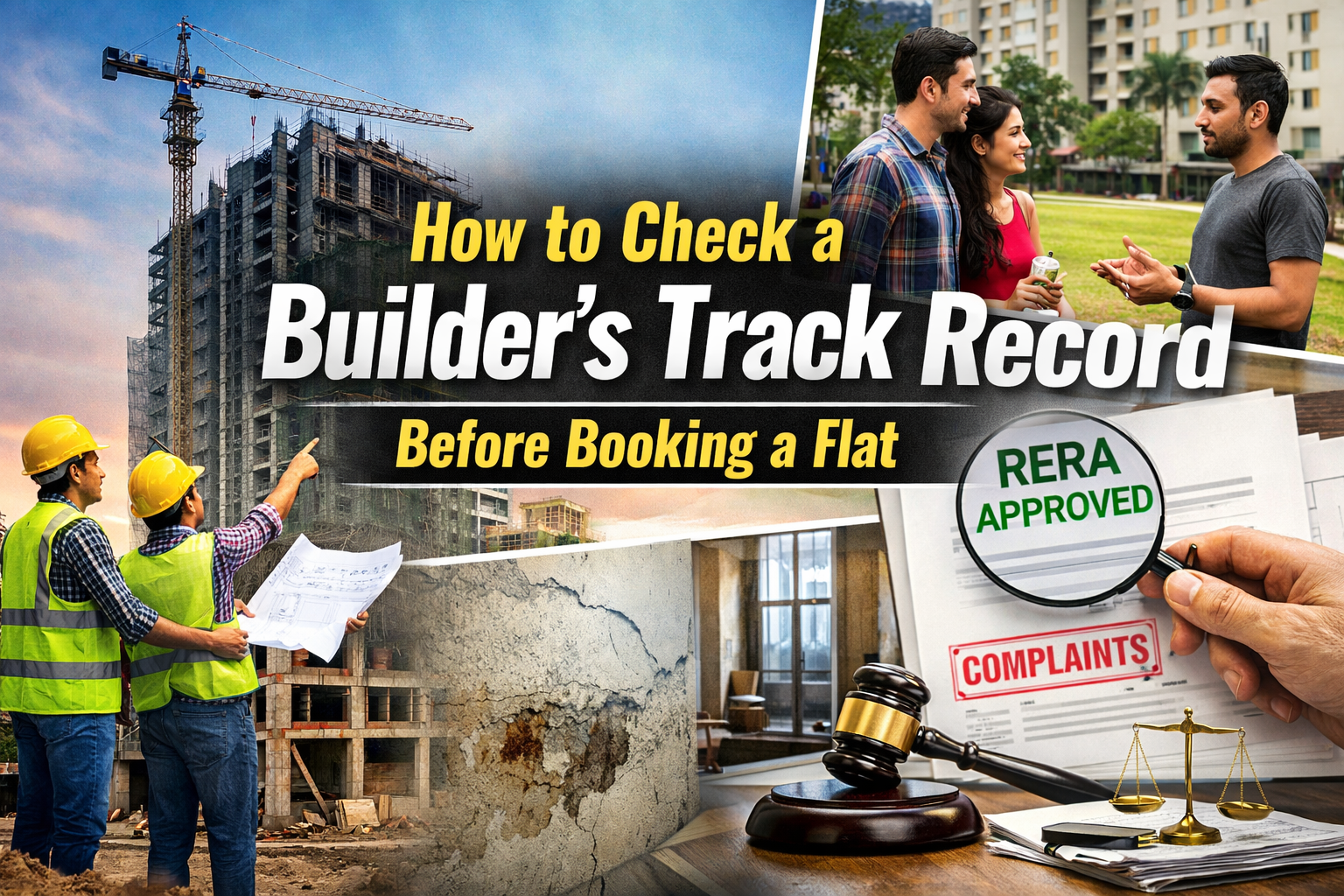
For most people, buying a flat is a once-in-a-lifetime decision. Yet many buyers focus only on price, floor plan, or location – and completely ignore the builder’s past record.
That’s where costly mistakes happen.
Before you pay the booking amount, you must ask one critical question:
Can this builder actually deliver what they promise?
This guide explains practical, verifiable ways to check a builder’s track record in India – so you don’t rely on sales talk, brochures, or paid reviews.
Index
- Why a Builder’s Track Record Matters More Than the Project
- Step 1: Check RERA Registration & Past Projects
- Step 2: Verify Possession History (Not Promised Dates)
- Step 3: Talk to Existing Flat Owners (Most Important)
- Step 4: Check Legal Cases & RERA Complaints
- Step 5: Evaluate Construction Quality in Older Projects
- Step 6: Check Financial Discipline & Funding
- Step 7: Don’t Trust Online Reviews Blindly
- Step 8: Check Builder Transparency
- Common Mistakes Buyers Make
- Simple Builder Track Record Checklist
- Final Takeaway
Why a Builder’s Track Record Matters More Than the Project
A good project on paper means nothing if the builder has a history of:
- Delayed possession
- Poor construction quality
- Legal disputes
- False promises
📌 Reality check: Even prime-location projects fail when the builder lacks execution discipline.
Step 1: Check RERA Registration & Past Projects
Start with the official source, not Google ads.
Every serious builder must be registered under
Real Estate Regulatory Authority (RERA).
What to check on the RERA portal:
- Number of completed projects
- Number of ongoing projects
- Any delayed or stalled projects
- Declared possession dates vs actual delivery
📌 Red flag: Multiple projects showing repeated extensions or overdue completion.
Step 2: Verify Possession History (Not Promised Dates)
Sales teams often say:
“All our past projects were delivered successfully.”
Don’t take this at face value.
How to verify:
- Compare original possession dates (from RERA or brochures)
- Check actual handover timelines
- Ask residents when they really got possession
📌 If a builder regularly delays by 1-2 years, expect the same pattern.
Step 3: Talk to Existing Flat Owners (Most Important)
Nothing beats ground reality.
Ask current residents:
- Was possession on time?
- Were amenities delivered as promised?
- Any water, electricity, or lift issues?
- How responsive is the builder after handover?
📌 Visit the society in the evening or weekend – that’s when residents are available.
Step 4: Check Legal Cases & RERA Complaints
A builder’s legal history reveals more than marketing material.
Where to look:
- State RERA complaint section
- Consumer court records
- High Court / District Court public listings (if available)
What matters:
- Repeated complaints for delay
- Refund disputes
- Possession-related cases
📌 One or two cases are normal. A pattern is not.
Step 5: Evaluate Construction Quality in Older Projects
Don’t judge quality from sample flats alone.
Visit a project that is:
- 3–5 years old
- Fully occupied
Check:
- Wall cracks
- Water seepage
- Lift condition
- Parking quality
- Drainage & common areas
📌 Poor maintenance soon after delivery usually means cost-cutting during construction.
Step 6: Check Financial Discipline & Funding
Builders with weak finances often delay projects.
Warning signs:
- Heavy discounts only to collect booking money
- Constant scheme changes
- Construction speed slowing down
Positive signs:
- Project funded by reputed banks
- Construction progress matching payment schedule
📌 Banks funding a project is not a guarantee, but it adds one layer of scrutiny.
Step 7: Don’t Trust Online Reviews Blindly
Many reviews are:
- Paid
- Written by channel partners
- Posted before possession
Better alternatives:
- Google Maps reviews of completed societies
- YouTube walkthroughs by independent residents
- Local real estate forums or WhatsApp groups
📌 Look for post-possession reviews, not launch-phase hype.
Step 8: Check Builder Transparency
A reliable builder is transparent about:
- Carpet area calculation
- Payment schedule
- Delay clauses
- Refund terms
Red flags:
- Vague answers
- “Standard agreement, sir”
- Refusal to share draft agreement before booking
📌 Transparency today = fewer disputes tomorrow.
Common Mistakes Buyers Make
- Choosing builder based only on brand name
- Ignoring past delays because “this project is different”
- Relying only on brokers or sales executives
- Not verifying documents independently
Simple Builder Track Record Checklist
Before booking, ensure:
- ✅ RERA record checked
- ✅ Past possession timelines verified
- ✅ Residents spoken to
- ✅ Legal complaints reviewed
- ✅ Older project quality inspected
If even 2–3 points raise doubts, pause and reassess.
Final Takeaway
A flat can look perfect on paper – but the builder decides your real experience.
Spending a few days checking a builder’s track record can save you:
- Years of delay
- EMI + rent burden
- Legal stress
- Financial loss
📌 Rule to remember:
Location attracts you. Price convinces you.
Builder track record protects you.
Can we get list of persons who have booked or invested in flats from Real Estate Builders. Whether Builder is bound mandatorily to provide such details to any new entry person who wants to book flat in the launched project.
In India, a real estate builder is generally NOT required to provide the list of buyers/investors who have already booked flats in a project to a new prospective buyer. However, the situation depends on certain laws and conditions, especially under the Real Estate (Regulation and Development) Act, 2016 (RERA).