
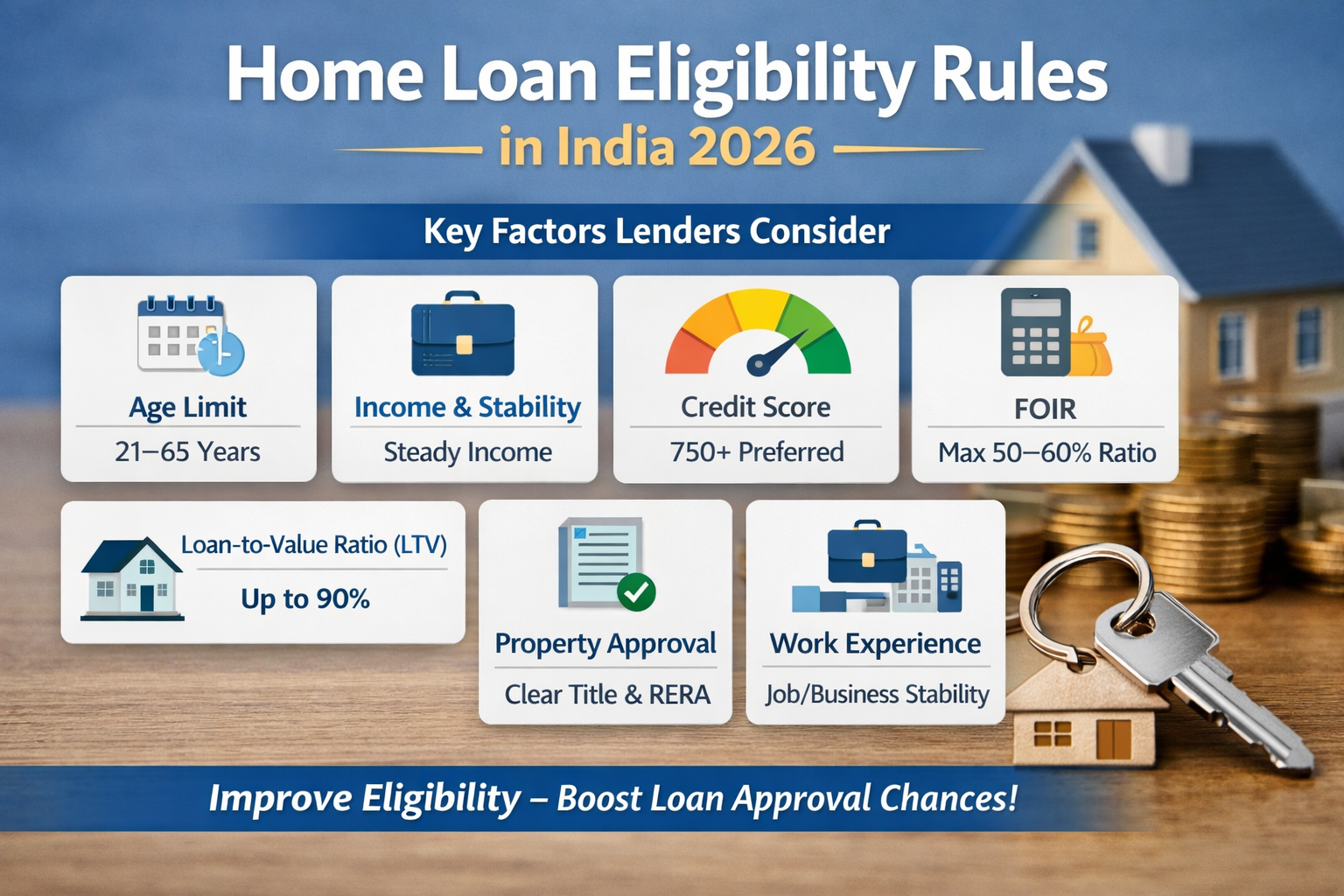
Buying a home is one of the biggest financial decisions for most Indian families. Before choosing a property or applying for a loan, it is important to clearly understand home loan eligibility rules. In 2026, eligibility norms in India continue to be shaped by income stability, credit discipline, property compliance, and regulatory frameworks set by the Reserve Bank of India (RBI).
This article explains home loan eligibility rules in India for 2026 in a clear, practical, and first-time-buyer-friendly manner. It focuses on what lenders check, why it matters, and how you can improve your eligibility without promotional or sales language.
Index
- What Is Home Loan Eligibility?
- Why Home Loan Eligibility Matters More in 2026
- Key Home Loan Eligibility rules in India 2026
- Eligibility by Applicant Type
- Home Loan Amount: How Banks Calculate Eligibility
- Documents Required for Home Loan Eligibility
- Impact of Eligibility on Borrowers
- Pros, Cons & Limitations of Eligibility Rules
- Role of Home Loan Eligibility Calculators
- Conclusion
- FAQs: Home Loan Eligibility Rules in India 2026
What Is Home Loan Eligibility?
Home loan eligibility refers to the maximum loan amount a bank or housing finance company is willing to offer you based on your financial profile and the property details.
Lenders use eligibility rules to ensure that:
- You can comfortably repay EMIs over the long term
- The loan does not create financial stress
- The property qualifies as acceptable collateral
Eligibility is not fixed. It varies across banks and borrowers.
Why Home Loan Eligibility Matters More in 2026
In recent years, lenders have become more cautious due to:
- Rising property prices in urban India
- Longer loan tenures (up to 30 years)
- Increased regulatory focus on borrower affordability
- Greater use of credit bureau data and analytics
As a result, eligibility checks in 2026 are stricter, more data-driven, and more transparent than before.
Key Home Loan Eligibility rules in India 2026
1. Age Criteria
Most lenders follow these age limits:
| Applicant Type | Minimum Age | Maximum Age at Loan Maturity |
|---|---|---|
| Salaried | 21 years | 60–65 years |
| Self-employed | 25 years | 65–70 years |
Why it matters:
Your age determines the loan tenure. Younger applicants qualify for longer tenures, which improves eligibility by lowering EMIs.
2. Income Criteria
Income is the most important eligibility factor.
For Salaried Individuals
- Stable monthly income
- Employment with government, PSU, MNC, or reputed private company
- Regular salary credits in bank account
For Self-Employed Individuals
- Consistent business or professional income
- Minimum 2–3 years of operational history
- Income supported by tax returns and financial statements
There is no fixed minimum salary, but most banks prefer:
- ₹25,000–₹30,000 per month in metro cities
- ₹20,000–₹25,000 per month in non-metros
3. Employment & Business Stability
Lenders check continuity, not just income amount.
- Salaried applicants: Minimum 2 years total experience, 6–12 months with current employer
- Self-employed applicants: Minimum 3 years in the same business or profession
Frequent job changes or inconsistent income can reduce eligibility.
4. Credit Score Requirement (CIBIL & Other Bureaus)
In 2026, credit score remains a non-negotiable factor.
| Credit Score Range | Impact on Eligibility |
|---|---|
| 750+ | Best rates & high eligibility |
| 700–749 | Good eligibility |
| 650–699 | Limited options |
| Below 650 | High rejection risk |
Lenders also review:
- Past loan repayment behaviour
- Credit card utilisation
- Number of active loans
5. Fixed Obligation to Income Ratio (FOIR)
FOIR measures how much of your income is already committed.FOIR=Monthly IncomeExisting EMIs + New EMI
Most banks allow:
- Up to 50–60% FOIR for higher incomes
- 40–50% FOIR for moderate incomes
Lower FOIR improves loan approval chances.
6. Loan-to-Value (LTV) Ratio
LTV defines how much of the property value the bank will finance.
| Property Value | Maximum Loan (Typical) |
|---|---|
| Up to ₹30 lakh | Up to 90% |
| ₹30–75 lakh | Up to 80% |
| Above ₹75 lakh | Up to 75% |
The remaining amount must be paid by the borrower as own contribution.
7. Property Eligibility Rules
Even if you qualify financially, the property must be eligible.
Banks usually check:
- Clear and marketable title
- Approved building plans
- Compliance with local development authority norms
- RERA registration (mandatory for most projects)
Unapproved or disputed properties can lead to rejection.
Eligibility by Applicant Type
Salaried Individuals
Generally enjoy:
- Higher acceptance rates
- Longer tenures
- Easier documentation
Key focus areas:
- Employer profile
- Salary consistency
- Credit score
Self-Employed Individuals
Eligibility depends more on:
- Profit stability
- Cash flow consistency
- Tax compliance
Banks usually consider:
- Average income of last 2–3 years
- Conservative income calculations
- Higher scrutiny of bank statements
Professionals (Doctors, CAs, Architects)
Professionals may receive:
- Preferential treatment
- Higher loan multipliers
- Flexible income assessment
Provided their practice is well-established and tax-compliant.
Home Loan Amount: How Banks Calculate Eligibility
Most lenders use income multiplier method.
Example (simplified):
- Monthly income: ₹80,000
- Allowed EMI: ₹40,000
- Tenure: 25 years
- Interest rate: Market-linked
This determines the maximum loan amount you qualify for.
Longer tenure = higher eligibility, but higher interest cost.
Documents Required for Home Loan Eligibility
Common Documents (All Applicants)
- PAN card (mandatory)
- Aadhaar / Passport / Voter ID
- Address proof
- Passport-size photographs
Income Proof
Salaried
- Last 3–6 months salary slips
- Form 16
- 6 months bank statements
Self-Employed
- 2–3 years ITR with computation
- Balance Sheet & P&L (CA certified)
- Business bank statements
Property Documents
- Sale agreement
- Title deed
- Approved plan
- Allotment letter (if applicable)
Impact of Eligibility on Borrowers
Cost Impact
- Higher eligibility may encourage larger loans
- Larger loans increase total interest outgo
Risk Impact
- Stretching eligibility can strain monthly finances
- Job or income disruption becomes riskier
Long-Term Impact
- Lower EMIs improve lifestyle flexibility
- Balanced eligibility supports long-term financial stability
Pros, Cons & Limitations of Eligibility Rules
Advantages
- Protects borrowers from over-borrowing
- Encourages disciplined financial behaviour
- Improves loan sustainability
Limitations
- Self-employed income may be under-assessed
- Cash-based earners face challenges
- Property compliance can delay approval
Role of Home Loan Eligibility Calculators
Eligibility calculators help you:
- Estimate loan amount before applying
- Compare scenarios with different tenures
- Plan property budget realistically
They are indicative tools and not final approval guarantees.
Conclusion
Home loan eligibility rules in India for 2026 focus on affordability, credit discipline, and property compliance. While interest rates may change, the core eligibility framework remains stable and borrower-centric.
Understanding these rules before applying:
- Improves approval chances
- Helps you choose the right property
- Prevents financial stress later
The best home loan is not the largest one you qualify for but the one you can comfortably repay.
FAQs: Home Loan Eligibility Rules in India 2026
1. What is the minimum salary required for a home loan in 2026?
There is no fixed minimum salary. Most banks prefer ₹20,000-₹30,000 monthly income depending on city and profile.
2. What credit score is ideal for home loan approval?
A credit score of 750 or above offers the best approval chances and interest rates.
3. Can self-employed individuals get a home loan easily?
Yes, if income is stable, tax returns are filed regularly, and financials are clear.
4. Does age affect home loan eligibility?
Yes. Younger borrowers qualify for longer tenures, which increases eligibility.
5. Can I get a home loan if I already have other EMIs?
Yes, but total EMIs must stay within the lender’s FOIR limits.
6. Is property eligibility as important as income eligibility?
Yes. Even financially strong applicants can be rejected due to property issues.
7. Can eligibility differ between banks?
Yes. Each lender uses its own internal assessment models.
8. Does higher tenure always improve eligibility?
It increases eligibility but also raises total interest cost.