
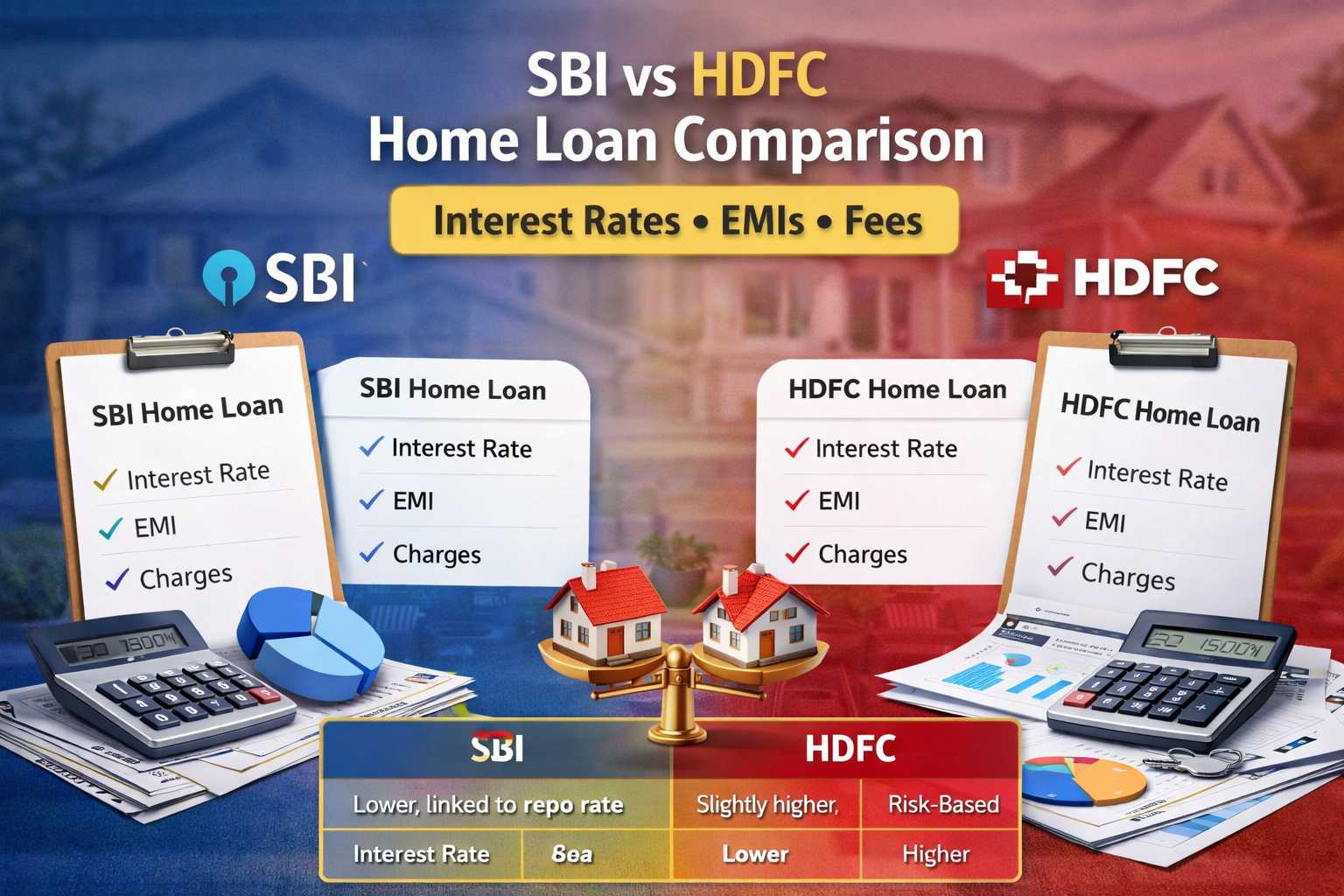
Choosing the right home loan is a long-term financial decision that affects your monthly cash flow, savings, and peace of mind for decades. Among Indian borrowers, the most common comparison is SBI vs HDFC Home Loan.
Both State Bank of India and HDFC Bank are trusted lenders with large customer bases, competitive interest rates, and wide product ranges. However, they differ in pricing approach, processing style, flexibility, and borrower experience.
This article explains the differences clearly and practically, helping you decide which home loan suits your financial profile, risk comfort, and long-term plans.
Index
- Understanding Home Loans in Simple Terms
- Why Comparing SBI vs HDFC Home Loan Matters
- SBI vs HDFC Home Loan: Key Comparison Table
- Interest Rate Comparison: SBI vs HDFC
- Eligibility & Borrower Profiles
- Loan Amount & LTV (Loan-to-Value)
- Processing Fees & Other Charges
- Prepayment & Foreclosure Rules
- Special Schemes & Product Flexibility
- Customer Experience & Service
- Long-Term Cost & Risk Impact
- Using EMI Calculators & Comparison Tools
- Conclusion
- Frequently Asked Questions (FAQs)
Understanding Home Loans in Simple Terms
A home loan is a long-term secured loan taken to:
- Buy a ready or under-construction property
- Construct a house on your own plot
- Renovate or extend an existing home
You repay the loan through EMIs (Equated Monthly Instalments), which include:
- Principal (loan amount)
- Interest (cost of borrowing)
Most home loans in India are floating-rate loans, linked to external benchmarks such as the RBI repo rate.
Why Comparing SBI vs HDFC Home Loan Matters
Even a 0.20% difference in interest rate can change your total interest cost by several lakhs over 20–30 years.
Comparing SBI and HDFC helps you understand:
- Who offers better long-term affordability
- Which bank is more flexible during income changes
- Where service experience differs
- How processing fees and policies affect total cost
This comparison is not about picking a “winner”, but choosing what fits your situation.
SBI vs HDFC Home Loan: Key Comparison Table
| Feature | SBI Home Loan | HDFC Home Loan |
|---|---|---|
| Lender Type | Public sector bank | Private sector bank |
| Interest Rate (Indicative) | Slightly lower on average | Slightly higher on average |
| Benchmark | Repo Linked Lending Rate (RLLR) | External benchmark-linked |
| Loan Amount | Up to ₹10 crore (property dependent) | Up to ₹10 crore (property dependent) |
| Loan Tenure | Up to 30 years | Up to 30 years |
| Processing Fee | Lower, often capped | Higher compared to SBI |
| Prepayment Charges | Nil on floating rate | Nil on floating rate |
| Women Concession | Available | Available (select schemes) |
| Processing Speed | Moderate | Faster |
| Branch Network | Very wide | Wide (urban-focused) |
Rates and charges vary based on profile, credit score, and scheme.
Interest Rate Comparison: SBI vs HDFC
SBI Home Loan Interest Rate
- Generally lower starting rates
- Directly linked to RBI repo rate
- Faster benefit transmission when RBI cuts rates
- Suitable for rate-sensitive borrowers
HDFC Home Loan Interest Rate
- Slightly higher starting rates
- Strong internal risk-based pricing
- Stable servicing over loan tenure
- Suitable for borrowers valuing consistency and service
Practical Impact Example
On a ₹50 lakh loan for 20 years:
- 0.25% higher rate can increase total interest by ₹2–3 lakh or more
- EMI difference may look small monthly, but adds up long-term
Eligibility & Borrower Profiles
Both banks cater to:
- Salaried individuals
- Self-employed professionals
- Business owners
- NRIs
Age Criteria
- SBI: Up to 75 years (loan end age)
- HDFC: Usually up to 65–70 years
This makes SBI slightly more flexible for:
- Late-career borrowers
- Joint loans with younger co-applicants
Loan Amount & LTV (Loan-to-Value)
Both SBI and HDFC:
- Finance up to 90% of property value (as per RBI norms)
- Lower LTV for higher-value properties
- Require down payment from borrower’s own funds
The final loan amount depends on:
- Income
- Existing EMIs
- Credit score
- Property type
Processing Fees & Other Charges
SBI
- Lower processing fee
- Often capped at a maximum amount
- Periodic fee waivers during festive offers
HDFC
- Processing fee up to 0.5% of loan amount
- Higher upfront cost
- Faster internal processing
Tip: Processing fee is a one-time cost, but interest rate affects you for decades.
Prepayment & Foreclosure Rules
For floating-rate home loans:
- Both SBI and HDFC charge zero prepayment penalty
- You can make partial prepayments anytime
- Early prepayments reduce interest significantly
SBI’s daily reducing balance structure can make early prepayment slightly more effective.
Special Schemes & Product Flexibility
SBI Home Loan Schemes
- Flexipay Home Loan
- SBI Privilege (for government employees)
- Shaurya (defence personnel)
- NRI Home Loan
- Balance Transfer & Top-up Loans
HDFC Home Loan Schemes
- Plot loans
- Home improvement loans
- Rural housing loans
- NRI/PIO loans
- Reach loans for informal income profiles
HDFC offers more niche and customised products, while SBI focuses on mass affordability.
Customer Experience & Service
SBI
Pros
- Strong trust factor
- Transparent pricing
- Large branch reach
Cons
- Slower processing
- More documentation
- Branch-dependent experience
HDFC
Pros
- Faster approvals
- Smoother digital journey
- Relationship manager support
Cons
- Higher charges
- More negotiation-dependent pricing
Long-Term Cost & Risk Impact
SBI May Suit You If:
- You want lower interest rates
- You plan frequent prepayments
- You prefer government-backed stability
- You are rate-sensitive
HDFC May Suit You If:
- You value speed and service
- You want flexible loan structuring
- Your income profile is complex
- You prefer smoother documentation handling
Using EMI Calculators & Comparison Tools
Before finalising:
- Use SBI and HDFC EMI calculators
- Compare EMI at different tenures
- Test rate increase scenarios
- Check total interest payable, not just EMI
This avoids surprises later.
Conclusion
There is no universal answer to “SBI vs HDFC Home Loan – which is better?”
- SBI is usually more cost-effective over the long term
- HDFC offers better convenience, speed, and product flexibility
Your choice should depend on:
- Income stability
- Risk tolerance
- Importance of service vs cost
- Long-term financial discipline
A well-chosen home loan is not the cheapest or fastest it is the one you can comfortably repay for 20–30 years.
Frequently Asked Questions (FAQs)
1. Which is cheaper: SBI or HDFC home loan?
SBI usually offers slightly lower interest rates, making it cheaper over the long term.
2. Is HDFC home loan easier to get than SBI?
HDFC generally has faster processing and smoother documentation, especially for salaried borrowers.
3. Do both banks offer zero prepayment charges?
Yes, both SBI and HDFC charge no prepayment penalty on floating-rate home loans.
4. Which bank is better for first-time home buyers?
SBI is better for affordability, while HDFC is better for handholding and speed.
5. Can I transfer my home loan from SBI to HDFC or vice versa?
Yes, balance transfer is allowed if eligibility criteria are met.
6. Which bank offers better customer service?
HDFC is often rated higher for service consistency, while SBI depends more on branch quality.
7. Are interest rates fixed or floating?
Most home loans from both banks are floating-rate loans linked to external benchmarks.
3 thoughts on “SBI vs HDFC Home Loan: Which One Is Better for You?”