
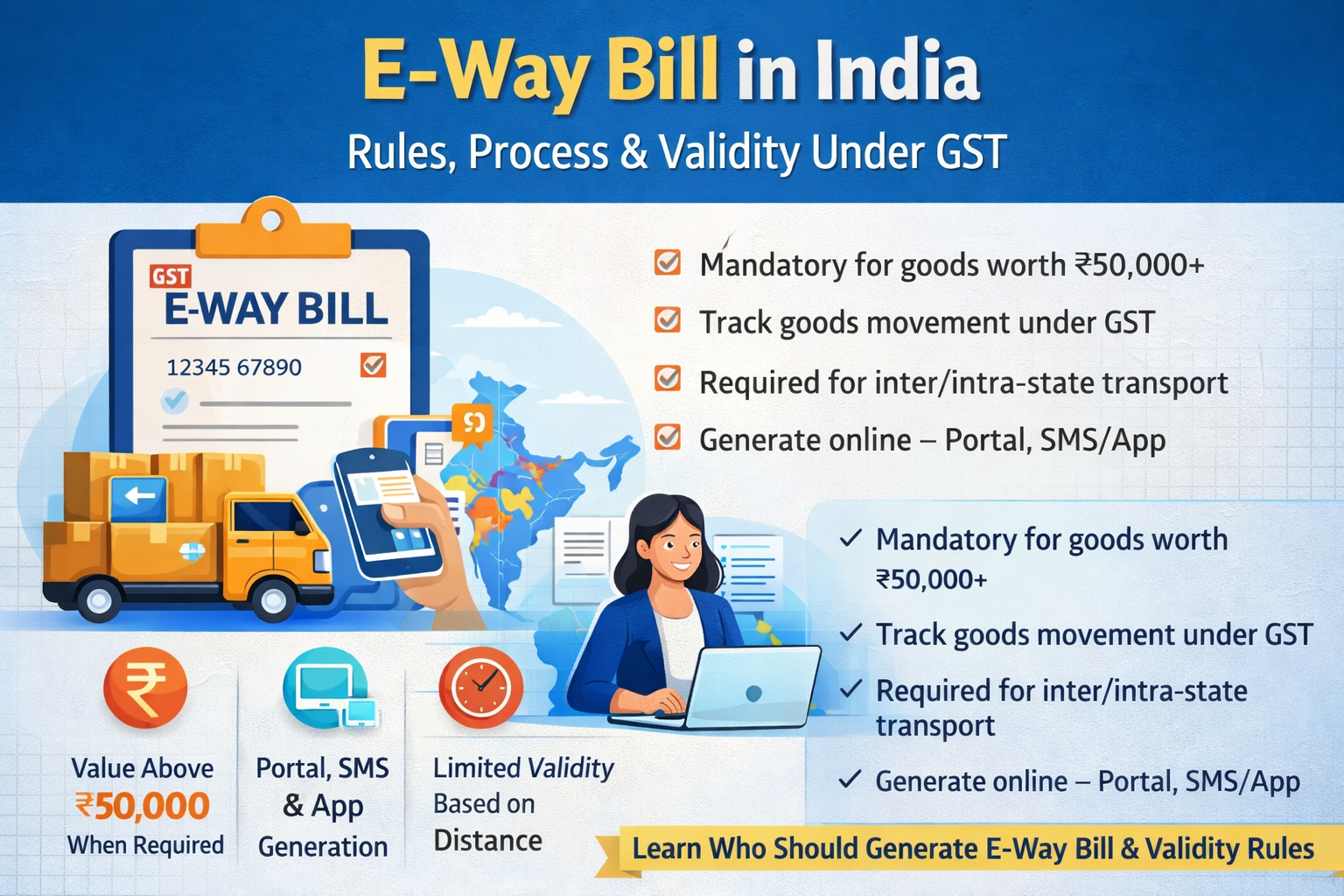
Moving goods across India under the Goods and Services Tax (GST) regime requires strict documentation. One of the most important documents for this purpose is the E-Way Bill. Since its introduction, the e-way bill system has replaced manual paperwork with a centralised, digital, and trackable mechanism for monitoring the movement of goods.
Whether you are a small trader, manufacturer, transporter, or a large logistics-driven business, understanding how the e-way bill works is essential to avoid penalties, detention of goods, and compliance issues.
This article explains what an e-way bill is, when it is required, who should generate it, state-wise rules, validity, and the complete generation process, in simple Indian English.
Index
- What Is an E-Way Bill?
- Why the E-Way Bill System Is Important
- Methods to Generate an E-Way Bill
- Components of an E-Way Bill (Form GST EWB-01)
- HSN Code Requirement in E-Way Bill
- When Should an E-Way Bill Be Generated?
- Who Should Generate an E-Way Bill?
- When Is E-Way Bill Not Required?
- State-Wise E-Way Bill Rules and Thresholds
- How to Generate E-Way Bill on the Portal
- How to Generate E-Way Bill via SMS
- Time Limit for Generating E-Way Bill
- Validity of an E-Way Bill
- Documents Required During Transportation
- Expert Conclusion
- Frequently Asked Questions (FAQs)
What Is an E-Way Bill?
An E-Way Bill is an electronic document generated on the GST e-way bill portal for the movement of goods worth more than ₹50,000.
It must be generated before goods are transported, irrespective of whether the movement is for:
- Supply
- Return
- Job work
- Transfer between branches
- Any other business purpose
Once generated, the system issues a 12-digit E-Way Bill Number (EBN). This number is shared with:
- Supplier
- Recipient
- Transporter
The EBN acts as a single reference during transit and for GST inspections.
Why the E-Way Bill System Is Important
The e-way bill system exists to:
- Track movement of goods in real time
- Prevent tax evasion
- Ensure GST compliance across states
- Reduce manual documentation errors
- Create transparency between supplier, recipient, and transporter
Without a valid e-way bill, goods can be detained, and penalties can be imposed under GST law.
Methods to Generate an E-Way Bill
The government allows multiple ways to generate or manage e-way bills so that businesses of all sizes can comply easily.
You can generate an e-way bill using:
- Web portal (ewaybillgst.gov.in)
- SMS facility
- Android mobile app
- API integration (for large businesses)
- Bulk upload (JSON file)
Before generating an e-way bill, it is important to verify GSTIN details using the GST search tool available on the portal.
Components of an E-Way Bill (Form GST EWB-01)
An e-way bill consists of two parts, each capturing different details.
Part A – Document & Goods Details
This part captures invoice-level information:
- GSTIN of supplier and recipient
- Document type (invoice, bill, challan)
- Document number and date
- From and to location with PIN codes
- Product name and HSN code
- Quantity and taxable value
- CGST, SGST, IGST, and Cess
- Reason for transportation
Who fills Part A?
The person causing movement of goods – usually the supplier or recipient.
Part B – Transport Details
This part captures transportation information:
- Transporter ID or GSTIN
- Vehicle number
- Transport mode (road, rail, air, ship)
- Approximate distance
- Transport document number
- Vehicle type
Who fills Part B?
The transporter, or the supplier/recipient if arranging transport themselves.
HSN Code Requirement in E-Way Bill
- Businesses with turnover above ₹5 crore:
Must use 6-digit HSN codes - Businesses with turnover up to ₹5 crore:
Can use 4-digit HSN codes
When Should an E-Way Bill Be Generated?
An e-way bill must be generated before the movement of goods if the consignment value exceeds ₹50,000.
Situations Where E-Way Bill Is Mandatory
- Goods value exceeds ₹50,000
- Movement for supply, return, or transfer
- Supplier is unregistered, but recipient is registered
- Supplier fails to generate the bill
- Transporter is carrying taxable goods
Even if the value is below ₹50,000, businesses may optionally generate an e-way bill for record-keeping.
Who Should Generate an E-Way Bill?
Responsibility depends on the nature of the transaction.
Registered Person
- Must generate an e-way bill for goods above ₹50,000
- Required to fill Part A
- Can generate for lower values voluntarily
Unregistered Person
- Still required to comply
- If supplying to a registered person, the registered recipient must ensure generation
Transporter
- Must generate the bill if supplier or recipient does not
- Can generate a Consolidated E-Way Bill (Form EWB-02) for multiple consignments
- May skip generation if each consignment is below ₹50,000 and not clubbed
When Is E-Way Bill Not Required?
An e-way bill is not required in certain cases, including:
- Goods transported by non-motorised vehicles
- Movement from customs port/airport to ICD or CFS
- Goods under customs supervision or seal
- Transit cargo to or from Nepal or Bhutan
- Movement by Ministry of Defence
- Empty cargo containers
- Transport to/from weighbridge within 20 km (with delivery challan)
- Rail transport by government or local authority
- Exempted goods notified by states
- Goods treated as no supply under Schedule III
Always check state-specific GST rules for exemptions.
State-Wise E-Way Bill Rules and Thresholds
While inter-state movement requires an e-way bill above ₹50,000, intra-state thresholds vary by state.
Examples of State Thresholds
| State | Threshold (₹) |
|---|---|
| Maharashtra | 1,00,000 |
| Delhi | 1,00,000 |
| Tamil Nadu | 1,00,000 |
| Rajasthan | 2,00,000 (within city) |
| Bihar | 1,00,000 |
| Most other states | 50,000 |
Always confirm the latest state rules before dispatch.
How to Generate E-Way Bill on the Portal
Step 1: Login
Visit the e-way bill portal and log in using your username, password, and captcha. First-time users must register with GSTIN.
Step 2: Select “Generate New”
From the dashboard, click E-Way Bill → Generate New.
Step 3: Fill Transaction Details
- Transaction type: Outward or Inward
- Sub-type: Supply, return, job work, etc.
- Document type and details
- Supplier and recipient details
- Item details with HSN, quantity, and tax
- Transport details (vehicle or transporter ID)
Step 4: Submit
Click submit. After validation, the system generates Form GST EWB-01 with a 12-digit EBN.
How to Generate E-Way Bill via SMS
SMS mode is useful in areas with low internet connectivity.
SMS Format (Illustrative)
EWBG GSTIN RecipientGSTIN Place InvoiceNo Date Value HSN Mode VehicleNo
After sending the SMS to the designated number, the system replies with the EBN.
Transporters can also update vehicle numbers via SMS during transit.
Time Limit for Generating E-Way Bill
From 1 January 2025:
- E-way bills can be generated only for documents dated within the last 180 days
- Older invoices are not eligible
Generate e-way bills close to dispatch to avoid rejection.
Validity of an E-Way Bill
Validity depends on distance and cargo type.
Validity Rules
| Goods Type | Distance | Validity |
|---|---|---|
| Standard goods | Up to 200 km | 1 day |
| Standard goods | Beyond 200 km | 1 day per 200 km |
| Over-dimensional cargo | Up to 20 km | 1 day |
| Over-dimensional cargo | Beyond 20 km | 1 day per 20 km |
Extension Rules
- Extension allowed 8 hours before or after expiry
- Total validity cannot exceed 360 days from generation
- Validity expires at midnight of the last day
Documents Required During Transportation
Road Transport
- Tax invoice or bill of supply
- E-way bill (EBN)
- Transporter ID or vehicle number
- Delivery challan (if applicable)
Rail / Air / Ship
- Tax invoice or bill of supply
- Transport document number and date
- Transporter ID
Officers may ask for additional documents during inspection.
Expert Conclusion
The e-way bill system is a critical GST compliance requirement for businesses involved in goods movement. While the rules may seem detailed, the digital system has made compliance easier, faster, and more transparent.
Understanding when to generate, who should generate, validity rules, and state thresholds helps businesses avoid penalties, reduce delays, and ensure smooth logistics operations.
For any business regularly transporting goods, e-way bill compliance is not optional—it is essential.
Frequently Asked Questions (FAQs)
Can I add two invoices in one e-way bill?
No. Each invoice requires a separate e-way bill. However, you can generate a consolidated e-way bill (EWB-02) for multiple consignments in one vehicle.
How can I download an e-way bill?
Log in to the portal, search using the EBN, and click Print to download the PDF.
How to cancel an e-way bill?
You can cancel within 24 hours of generation if goods are not transported. Cancellation is not allowed after that.
Can e-way bill details be modified?
Part A details cannot be changed. Only Part B (vehicle/transporter details) can be updated.
Is e-way bill required for services?
No. E-way bills apply only to goods, not services.
Is e-way bill required within 10 km?
Yes, if the consignment value exceeds the applicable threshold, even for short distances.
Can e-way bill be generated without GSTIN?
Unregistered transporters can generate using a Transporter ID obtained from the portal.
How is consignment value calculated?
It is the total taxable value of goods in a single invoice, not per item.
What happens if e-way bill is not generated?
Goods may be detained, and penalties can be imposed under GST law.
How many e-way bills are needed if multiple transporters are involved?
Only one e-way bill per consignment. Update Part B when transporter changes.