
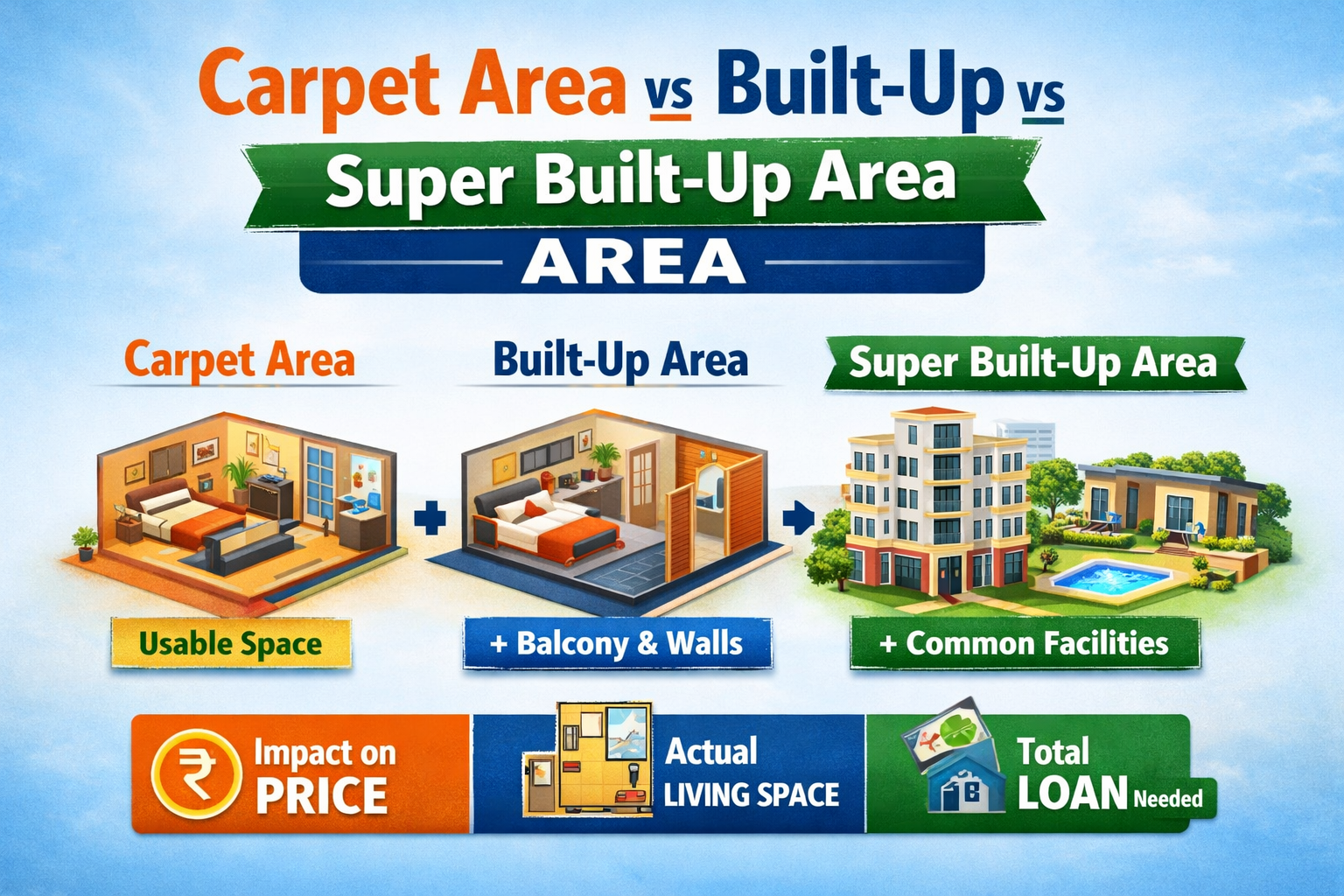
For a first-time home buyer in India, terms like carpet area, built-up area, and super built-up area often sound confusing. Builder brochures, property ads, and even sales discussions freely use these terms, sometimes interchangeably. However, they do not mean the same thing.
Understanding the difference is critical because property prices in India are linked to square footage. If you don’t clearly know what area you are paying for, you may end up paying a premium for space you can’t actually use.
This article explains these concepts in simple Indian English, with practical examples, so you can make informed property decisions.
Index
- Why Area Definitions Matter in Property Buying
- What Is RERA and Why It Changed Everything
- What Is Carpet Area?
- What Is Built-Up Area?
- Carpet Area vs Built-Up Area
- What Is Super Built-Up Area?
- Understanding the Loading Factor
- Super Built-Up Area vs Built-Up Area
- Practical Impact on Home Buyers
- Pros, Cons, and Limitations
- Tools and Practical Tips for Buyers
- Conclusion
- FAQs: Carpet Area vs Built-Up vs Super Built-Up Area
Why Area Definitions Matter in Property Buying
When you buy a flat, you are not just buying a home you are buying measured space. Even a small misunderstanding of area definitions can lead to:
- Paying more than expected
- Misjudging actual usable space
- Difficulty comparing two properties fairly
- Confusion during possession or registration
To address these long-standing issues, the Indian government introduced Real Estate Regulatory Act (RERA), which brought transparency and standardization to how property area is defined and sold.
What Is RERA and Why It Changed Everything
RERA came into force in 2016 to regulate real estate transactions and protect home buyers. One of its most important changes was:
Builders must sell residential units based only on carpet area.
Before RERA, developers often advertised flats using built-up or super built-up area, which included common spaces. Buyers were left guessing how much space they could actually use inside the home.
With RERA:
- Carpet area must be clearly disclosed
- Sale agreements must mention carpet area
- Any variation beyond permitted limits requires refund
This reform helped buyers compare properties on a like-to-like basis.
What Is Carpet Area?
Simple Definition
Carpet area is the net usable area inside the flat, measured from wall to wall.
In simple words, it is the area where you can actually spread a carpet and walk freely.
What Is Included in Carpet Area
- Living room
- Bedrooms
- Kitchen
- Bathrooms
- Area under internal partition walls
- Internal staircase (if inside the flat)
What Is Excluded
- External walls
- Balcony or veranda
- Open terrace
- Common areas (lifts, lobby, stairs outside the flat)
Key Point Under RERA
- Builders can increase carpet area by maximum 3%
- Any excess increase requires buyer consent
- Any reduction requires refund to the buyer
Carpet area gives the most realistic picture of usable living space.
What Is Built-Up Area?
Simple Definition
Built-up area = Carpet area + thickness of walls + balcony
It includes everything that forms part of your individual flat structure.
Built-Up Area Typically Includes
- Carpet area
- Internal and external walls
- Balcony or attached veranda
Important Difference
- Built-up area is always larger than carpet area
- Carpet area is usually 70–75% of built-up area
Example
If built-up area = 1,500 sq ft
Then carpet area ≈ 1,050–1,125 sq ft
This difference explains why two flats with the same built-up area may feel different in size when you walk inside.
Carpet Area vs Built-Up Area
| Aspect | Carpet Area | Built-Up Area |
|---|---|---|
| Usability | Fully usable | Partially usable |
| Includes walls | ❌ No | ✅ Yes |
| Includes balcony | ❌ No | ✅ Yes |
| RERA sales basis | ✅ Yes | ❌ No |
| Buyer clarity | High | Medium |
What Is Super Built-Up Area?
Simple Definition
Super built-up area = Built-up area + proportionate share of common areas
This concept was widely used by builders before RERA.
Common Areas Included
- Lifts
- Corridors
- Staircases
- Lobby
- Clubhouse
- Gym
- Swimming pool
- Gardens
- Utility ducts
You do not own these areas individually, but you share access with other residents.
Understanding the Loading Factor
The difference between carpet area and super built-up area is called the loading factor.
Typical Loading Factor
- Usually ranges between 20% to 30%
- Higher amenities = higher loading
Example Calculation
- Carpet area = 2,000 sq ft
- Loading = 25%
Super built-up area =
2,000 × (1 + 0.25) = 2,500 sq ft
This means you are paying for 500 sq ft of shared space.
Super Built-Up Area vs Built-Up Area
| Aspect | Built-Up Area | Super Built-Up Area |
|---|---|---|
| Personal access | Yes | Partially |
| Includes common areas | ❌ No | ✅ Yes |
| Used for pricing earlier | Yes | Yes |
| RERA-approved sales basis | ❌ No | ❌ No |
Proportionate Allocation Example
If two flats on a floor are:
- Flat A: 700 sq ft built-up
- Flat B: 1,400 sq ft built-up
Common area = 1,200 sq ft
Allocation ratio = 1:2
- Flat A gets 400 sq ft
- Flat B gets 800 sq ft
Super built-up area:
- Flat A = 1,100 sq ft
- Flat B = 2,200 sq ft
Practical Impact on Home Buyers
Cost Impact
- Price per sq ft looks cheaper on super built-up basis
- Carpet area gives true cost visibility
Comparison Impact
- Two flats priced similarly may differ significantly in usable space
- Always compare price per carpet sq ft
Long-Term Impact
- Carpet area determines:
- Furniture planning
- Renovation scope
- Actual comfort
Pros, Cons, and Limitations
Carpet Area
Pros
- Transparent
- Accurate
- RERA-protected
Cons
- Smaller number may feel misleading initially
Built-Up Area
Pros
- Shows structural size
Cons
- Not fully usable
- Can confuse buyers
Super Built-Up Area
Pros
- Reflects shared amenities
Cons
- Inflates perceived flat size
- Not buyer-friendly
Tools and Practical Tips for Buyers
- Always ask for carpet area in writing
- Check carpet area mentioned in:
- Sale agreement
- Builder brochure
- RERA registration details
- Use home loan EMI calculators based on total cost, not advertised area
- Visit sample flat and measure rooms if possible
Conclusion
Understanding the difference between carpet area, built-up area, and super built-up area is essential for every Indian home buyer. RERA has significantly improved transparency by making carpet area the standard for sale, but marketing jargon still exists.
If you want to know:
- How much space you will actually use → Carpet area
- Structural size of your flat → Built-up area
- Shared facilities contribution → Super built-up area
An informed buyer is less likely to face disappointment and more likely to make a confident, financially sound property decision.
FAQs: Carpet Area vs Built-Up vs Super Built-Up Area
1. What area should I consider while buying a flat under RERA?
Only carpet area should be considered for pricing and comparison.
2. Can builders still quote super built-up area?
They may mention it for information, but sale must be based on carpet area.
3. Is balcony included in carpet area?
No. Balcony is excluded from carpet area.
4. Why does my flat feel smaller than advertised earlier?
Earlier ads used super built-up area, which includes common spaces.
5. What is a good loading factor?
A loading of 20–25% is generally considered reasonable.
6. Can carpet area change after possession?
Yes, but only within 3% limit under RERA norms.
7. Does carpet area affect home loan eligibility?
Indirectly yes, as loan amount depends on total property cost.
8. Which area matters for resale value?
Carpet area is increasingly becoming the benchmark for resale comparisons.