
You’re about to invest lakhs or even crores into a property, but you’re unsure whether the project is legally safe or not. You’re not alone. Before the Real Estate (Regulation and Development) Act, 2016 (RERA) came into force, thousands of homebuyers in India faced delays, fraud, and incomplete projects.
Even today, many buyers don’t verify whether a project is actually RERA approved they simply trust brochures or sales agents. That’s risky. A single mistake can lock your money in a stalled project for years.
Understanding RERA approved projects is no longer optional it’s essential if you want financial security, transparency, and peace of mind.
In this guide, you’ll learn:
- What RERA approved projects really mean
- Why they matter for your home loan and legal safety
- How to check RERA registration online (step-by-step)
- Real examples with ₹ values
- Common mistakes Indian buyers make
What Are RERA Approved Projects?
A RERA approved project is a real estate project that is registered with the respective state’s Real Estate Regulatory Authority under the Real Estate (Regulation and Development) Act, 2016.
In simple terms, it means:
- The project is legally verified
- The builder has submitted all approvals
- You can track project progress online
- Your rights as a buyer are protected
For example, in Maharashtra, projects are registered under MahaRERA, while in Uttar Pradesh it’s UP RERA.
Real Example (₹ Scenario)
Suppose you’re buying a 2BHK in Pune worth ₹75 lakh:
- In a RERA approved project, 70% of your money (₹52.5 lakh) is legally protected in an escrow account
- In a non-RERA project, your money can be diverted to other projects
That’s a huge difference in risk.
Why This Matters
Before RERA, builders could:
- Delay projects indefinitely
- Change layouts without consent
- Mislead buyers on carpet area
Now, RERA approval ensures accountability.
Why RERA Approval Is Important for Home Buyers
Buying property isn’t just emotional it’s financial planning for the next 20–30 years, especially if you’re taking a home loan.
Banks like State Bank of India or HDFC Bank prefer funding RERA approved projects because they reduce risk.
1. Financial Protection (Escrow Rule)
Under RERA:
- 70% of funds collected from buyers must be kept in a separate account
- Funds can only be used for construction
Example:
You pay ₹10 lakh booking + ₹20 lakh loan disbursement
→ ₹21 lakh is protected for your project only
This prevents builders from misusing funds.
2. Timely Project Completion
Builders must:
- Declare project completion timelines
- Pay penalties for delays
Example:
If possession is promised by Dec 2027, delay can result in:
- Compensation or interest payout to you
3. Transparency in Carpet Area
RERA standardizes carpet area:
- No misleading “super built-up” tricks
- You pay only for usable space
Example:
- Advertised: 1200 sq ft
- Carpet area: 800 sq ft
Under RERA, pricing must be based on 800 sq ft, not inflated numbers.
4. Legal Protection
If issues arise, you can file a complaint with your state RERA authority.
Example:
If builder delays possession by 12 months, you can:
- Claim compensation
- File complaint online
Key Features of RERA Approved Projects
RERA isn’t just registration it’s a complete framework that standardizes real estate in India.
1. Mandatory Registration
Projects must register if:
- Land area > 500 sq meters, OR
- More than 8 apartments
Without registration:
- Builder cannot advertise or sell
2. Detailed Project Disclosure
Builders must upload:
- Layout plans
- Approvals
- Land title documents
- Timeline
This ensures zero hidden surprises.
3. 5-Year Defect Liability
If structural defects appear within 5 years:
- Builder must fix them
Example:
If cracks appear in walls within 3 years → builder must repair free of cost
4. Consent-Based Changes
- Minor changes → must be informed
- Major changes → require 2/3rd buyer approval
5. Equal Penalty Structure
Earlier:
- Buyers paid heavy penalties
- Builders paid nothing
Now:
- Both are treated equally
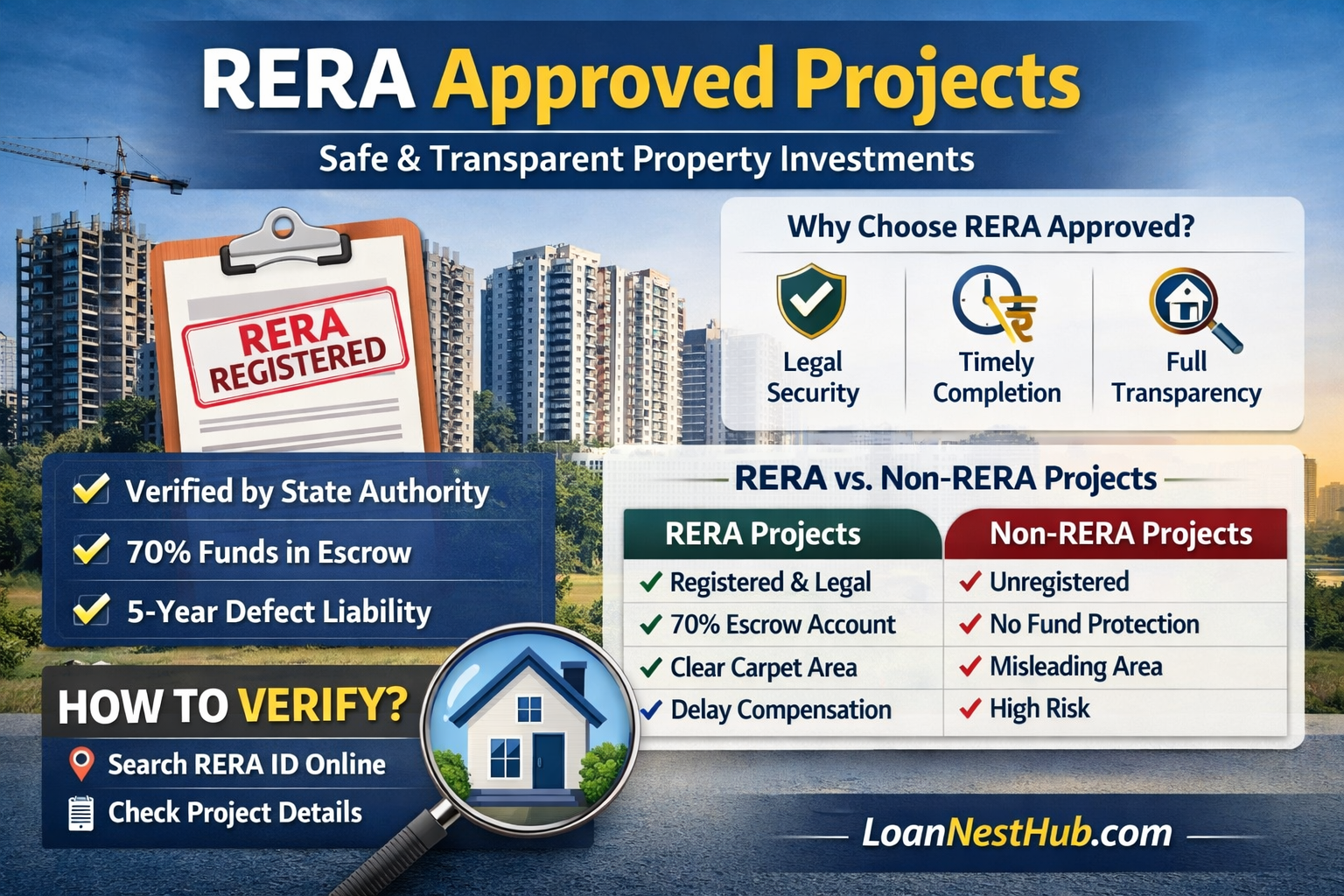
RERA Approved vs Non-RERA Projects (Comparison)
| Feature | RERA Approved Projects | Non-RERA Projects |
|---|---|---|
| Legal Registration | Mandatory | Not required |
| Fund Safety | 70% escrow protection | No protection |
| Transparency | High (online updates) | Low |
| Carpet Area Clarity | Standardized | Often misleading |
| Delay Compensation | Applicable | Rare |
| Home Loan Approval | Easier | Difficult |
Practical Example
You buy a flat for ₹60 lakh in Mumbai:
- RERA project: Loan approved quickly + legal safety
- Non-RERA project: Bank may reject or delay loan
This directly impacts your EMI planning.
Which Projects Must Be Registered Under RERA?
Not all projects need RERA registration but most do.
Must Be Registered:
- Residential apartments
- Commercial projects
- Plotted developments
- Ongoing projects without OC/CC
Not Required:
- Projects < 500 sq m
- Less than 8 units
- Pure renovation projects
Important Insight
Each phase of a project:
- Requires separate RERA registration
Example:
If a township has 3 phases → each phase must be registered individually
How to Check RERA Approved Projects Online
This is the most important step before buying.
Step-by-Step Process
- Visit your state RERA website
- Example: MahaRERA
- Click on “Registered Projects”
- Enter:
- Project name OR
- Builder name OR
- Registration number
- Check:
- Completion date
- Litigation details
- Approvals
Real Example
You search a Pune project priced at ₹90 lakh:
- Completion: Dec 2026
- Status: 65% complete
- Litigation: None
This gives confidence before paying booking amount.
RERA Registration Process for Builders
Understanding this helps you judge project credibility.
Step 1: Online Application
Builder submits:
- Land title
- Approvals
- Layout
Step 2: Fee Payment
Fees vary by state:
- ₹10–₹50 per sq meter (approx range)
Step 3: Verification
Authority checks:
- Legal ownership
- Past record
Step 4: Registration Certificate
Issued within 30–60 days
Why This Matters to You
If a builder clears this process:
- Chances of fraud reduce significantly
Expert Tips for Buyers (Must Read)
1. Always Verify RERA Number
Don’t trust brochures verify online.
2. Match Carpet Area
Ensure agreement matches RERA data.
3. Check Past Projects
Look at builder’s delivery history.
4. Don’t Ignore Delays
Even RERA projects can delay track progress regularly.
5. Loan Advantage Tip
Banks prefer RERA projects → faster approval + better negotiation power.
Read: documents required for home loan India
FAQs
1. Is it mandatory to buy only RERA approved projects?
No, but it is strongly recommended because non-RERA projects carry higher risk.
2. Can I get a home loan for non-RERA projects?
It’s difficult. Banks prefer RERA registered projects for risk management.
3. How do I find a project’s RERA number?
Builder website
Brochure
RERA official portal
4. What if a builder delays a RERA project?
Claim compensation
File complaint with RERA authority
5. Is RERA applicable across India?
Yes, but each state has its own authority like MahaRERA or UP RERA.
Conclusion
RERA approved projects have transformed India’s real estate market by bringing transparency, accountability, and financial protection.
Before booking any property:
- Always verify RERA registration
- Check project details online
- Prefer RERA-approved properties for smoother home loan approval
This one step can save you lakhs and years of stress.
If you’re planning to take a home loan next, don’t miss our guide:
👉 home loan eligibility criteria India