
You want to plan your daily commute or property search in Lucknow, but you’re unsure how the metro actually connects different areas. You’re not alone metro-related searches in Uttar Pradesh have grown significantly as urban travel shifts away from congested roads.
The problem is, most guides only show station names without explaining travel time, real costs, or how it affects your daily routine or property decisions. This makes it harder to decide whether living near a metro line is actually worth it.
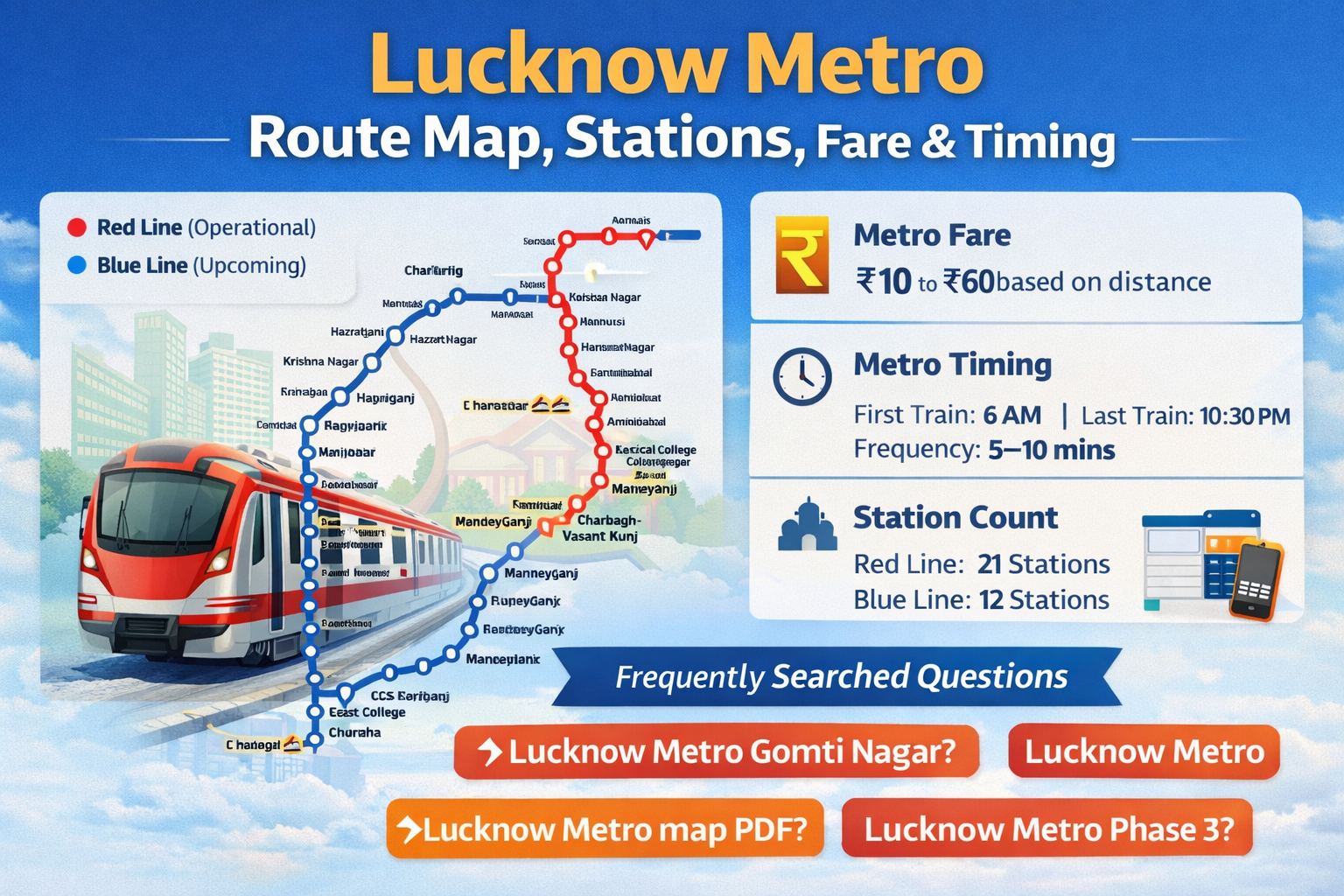
In this guide, you’ll get a complete breakdown of the Lucknow Metro map, route, stations list, fare, and timing 2026 along with practical examples, travel cost comparisons, and insights useful for both commuters and property buyers.
What is Lucknow Metro & Why It Matters
The Lucknow Metro Rail Corporation operates a modern rapid transit system designed to reduce traffic congestion and provide reliable public transport in Lucknow.
Why it matters for you
If you commute daily, metro travel can significantly cut both time and cost.
Example:
- Daily cab cost (10 km one-way): ₹250–₹350
- Monthly cost (office commute): ~₹10,000
- Same route via metro: ₹40 per trip → ~₹2,400/month
That’s a saving of ₹7,000+ per month.
Key benefits
- Predictable travel time (no traffic delays)
- Lower cost vs cabs/auto
- Direct airport connectivity
- Cleaner and safer commute
For property buyers, proximity to metro stations often improves rental demand and resale value.
Lucknow Metro Map & Route Overview
The Lucknow Metro currently operates mainly on the Red Line (North–South Corridor).
Operational Route
- CCS Airport → Munshipulia
- Total length: ~23 km
- Total stations: 21
Why this route is important
This corridor connects:
- Airport
- Railway station (Charbagh)
- Government offices (Sachivalaya)
- Commercial hubs (Hazratganj)
- Residential areas (Indira Nagar)
Example:
If you live in Indira Nagar and work near Hazratganj, your travel:
- Road: 35–50 minutes (peak traffic)
- Metro: ~18 minutes
That’s nearly 50% time saving daily.
Lucknow Metro Stations List – Red Line
Here’s the complete operational stations list:
Elevated + Underground Mix
- CCS Airport
- Amausi
- Transport Nagar
- Krishna Nagar
- Singar Nagar
- Alambagh
- Alambagh Bus Station
- Mawaiya
- Durgapuri
- Charbagh
- Hussainganj
- Sachivalaya
- Hazratganj
- KD Singh Stadium
- Vishwavidyalaya
- IT Chauraha
- Badshah Nagar
- Lekhraj Market
- Bhootnath Market
- Indira Nagar
- Munshipulia
Why station layout matters
Underground stations (like Hazratganj) are located in high-density commercial zones. Elevated stations dominate residential areas, reducing construction cost and improving expansion feasibility.
Upcoming Blue Line (East–West Corridor)
The proposed Blue Line will improve connectivity in Old Lucknow.
Proposed route
- Charbagh → Vasant Kunj
Key stations include:
- Aminabad
- Pandeyganj
- Medical College
- Thakurganj
- Musabagh
Why this matters
Old Lucknow areas currently rely heavily on road transport.
Example:
Aminabad to Charbagh:
- Road: 30–40 mins
- Expected metro: ~10 mins
This line will significantly reduce congestion in dense market areas.
Lucknow Metro Timing & Frequency
Timing is one of the most important factors for daily planning.
Official timings (2026)
| Particular | Timing |
|---|---|
| First Train | 6:00 AM |
| Last Train | 10:30 PM |
| Peak Frequency | 5–6 minutes |
| Non-Peak | 7–10 minutes |
| End-to-End Time | ~40 minutes |
Practical example
If you catch the metro at 8:30 AM:
- Next train arrives within ~5 minutes
- No waiting like buses or autos
This reliability is why office-goers prefer metro over road travel.
Lucknow Metro Fare Structure (With Examples)
Lucknow Metro uses a distance-based fare system, making it affordable for most users.
Fare table
| Stations Travelled | Fare (₹) |
|---|---|
| 1 station | 10 |
| 2 stations | 15 |
| 3–6 stations | 20 |
| 7–9 stations | 30 |
| 10–13 stations | 40 |
| 14–17 stations | 50 |
| 18+ stations | 60 |
Real-life cost example
Route: Airport → Hazratganj
- Distance: ~12 stations
- Fare: ₹40
Compare with alternatives:
- Auto: ₹200–₹300
- Cab: ₹350–₹500
Monthly savings (office commute): ₹5,000–₹8,000
Ticket Options & Online Booking
Lucknow Metro offers multiple ticket options depending on your usage.
1. Token Ticket
- Single journey
- Best for occasional travellers
2. GoSmart Card
- Rechargeable
- ~10% discount
- Ideal for daily users
3. Tourist Card
- Unlimited rides
- 1-day / 2-day validity
Online booking options
- Mobile apps
- UPI recharge
- Station kiosks
Why smart cards matter
If you travel daily:
- Monthly spend without card: ₹2,400
- With 10% discount: ~₹2,160
Small savings but meaningful over time.
Metro Connectivity in Key Areas (Gomti Nagar)
Gomti Nagar is one of Lucknow’s biggest residential and commercial hubs.
Nearest metro stations
- Indira Nagar
- Bhootnath Market
- Lekhraj Market
- Badshah Nagar
Practical impact
If your office is in Hazratganj:
- Travel time: ~20 minutes
- Cost: ₹30–₹40
Property insight
- Flats near metro stations often command 10–20% higher rent
- Better resale demand due to connectivity
Impact on Property Prices & Rental Demand
Metro connectivity directly influences real estate decisions.
Example comparison
| Area | Without Metro | With Metro |
|---|---|---|
| Indira Nagar Rent (2BHK) | ₹14,000 | ₹16,000–₹18,000 |
| Travel Cost | ₹5,000/month | ₹2,500/month |
Why this happens
- Reduced commute time
- Higher tenant demand
- Better accessibility
However, always verify:
- Whether the metro is operational, not just proposed
- Distance from station (ideal: within 1 km)
Expert Tips for Daily Commuters
1. Use Smart Cards Instead of Tokens
You save time and money. Tokens can create queues during peak hours.
2. Avoid Peak Hours (8–10 AM, 6–8 PM)
Crowding increases significantly.
3. Choose Homes Within Walking Distance
Living 500–800 metres from a station is ideal.
4. Plan First-Mile Connectivity
Metro works best when autos/e-rickshaws are easily available near stations.
5. Track Expansion Carefully
Don’t buy property based on proposed routes alone—construction delays are common.
FAQs – Lucknow Metro
1. What is the minimum Lucknow Metro fare?
The minimum fare is ₹10 for one station.
2. What are Lucknow Metro timings?
First train starts at 6:00 AM, last train runs till 10:30 PM.
3. How to buy Lucknow Metro tickets online?
You can recharge smart cards via mobile apps, UPI, or station kiosks.
4. Which metro stations serve Gomti Nagar?
Indira Nagar, Bhootnath Market, Lekhraj Market, and Badshah Nagar.
5. Is Lucknow Metro map PDF available?
Yes, you can download it from official metro sources for offline use.
Conclusion
The Lucknow Metro map, route, stations list, fare, and timing are essential for planning both daily travel and property decisions. The Red Line already offers strong connectivity from airport to residential zones, while upcoming corridors will expand coverage further.
For you as a commuter, metro means predictable travel, lower cost, and better time management. For property buyers, living near operational metro lines can improve both convenience and long-term value.
If you’re planning a home purchase based on connectivity, use our Home Loan EMI Calculator or explore Best Areas to Buy Property in Lucknow before making a decision.