
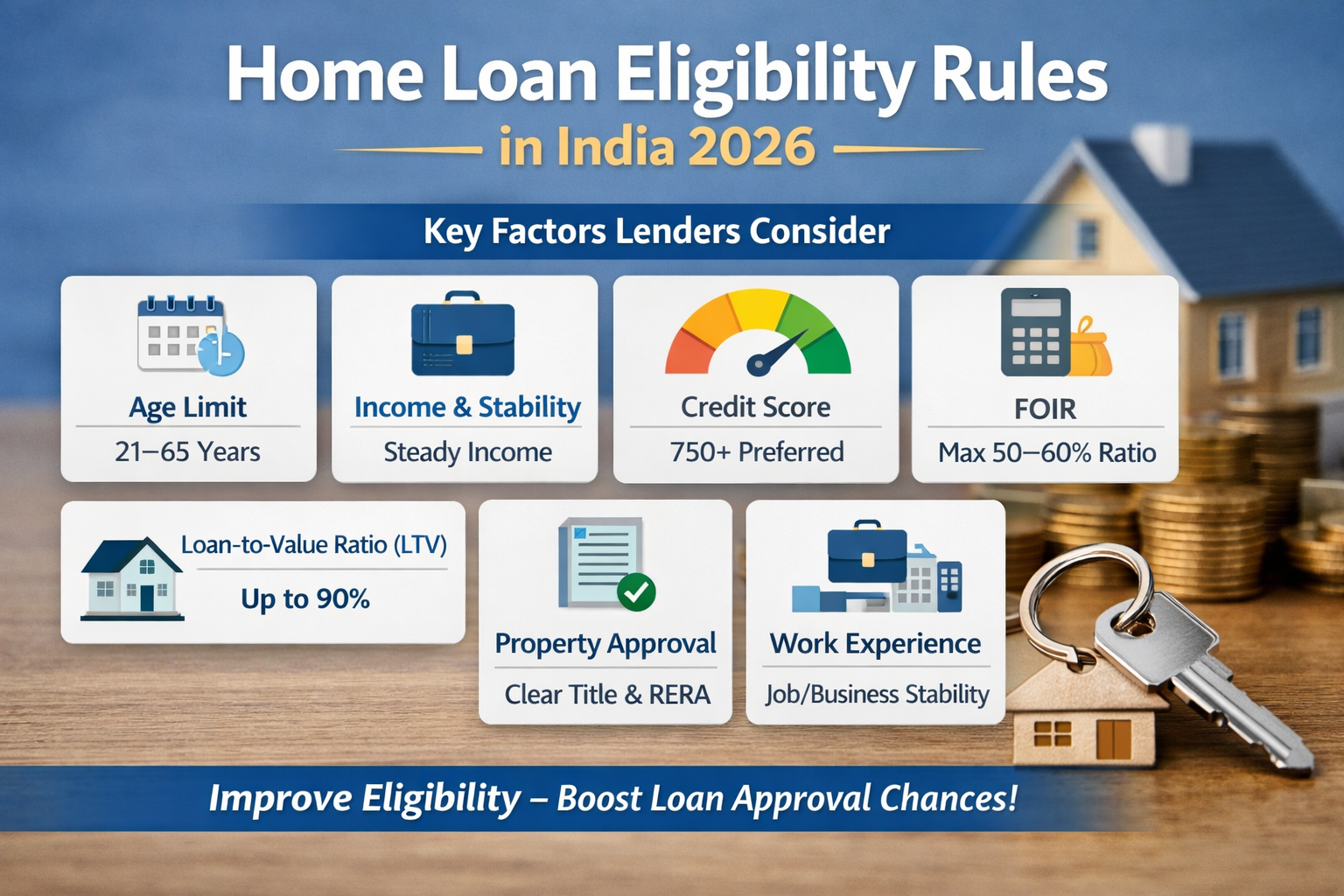
You may be earning ₹50,000 – ₹1 lakh per month and still unsure how much home loan you can actually get approved for. You’re not alone – banks in India reject or reduce nearly 30 – 40% of applications due to eligibility mismatches, not income shortage.
The problem is, eligibility is not just about salary. Banks look at FOIR, credit score, job stability, and even the property you choose. Missing even one factor can reduce your loan amount by ₹10 – 20 lakh.
This makes planning your home purchase confusing and risky, especially if you don’t understand how lenders evaluate your profile.
In this guide, you’ll learn exact home loan eligibility criteria in India for 2026, how banks calculate your loan amount, and how to improve your chances of approval with practical examples.
What is Home Loan Eligibility?
Home loan eligibility refers to the maximum loan amount a bank is willing to give you based on your financial profile and property details.
Banks like State Bank of India, HDFC Bank, and ICICI Bank follow structured models to assess whether you can repay the loan comfortably over 20–30 years.
Example:
If you earn ₹80,000/month, you may assume you can get a ₹70 lakh loan.
But after FOIR and obligations, the bank may approve only ₹45–50 lakh.
Why? Because eligibility depends on:
- Your existing EMIs
- Your credit score
- Your age and job stability
- The property value and approval status
This is why understanding eligibility before choosing a property is critical.
Why Eligibility Rules Matter More in 2026
In 2026, lenders are stricter due to guidance from Reserve Bank of India and rising financial risks.
Key changes impacting eligibility:
- Higher property prices in cities like Pune, Mumbai, Bangalore
- Increased use of credit bureau data (CIBIL, Experian)
- Focus on FOIR limits (40–60%)
- Preference for stable income over high income
Example:
In Pune:
- Property price: ₹80 lakh
- Loan required: ₹65 lakh
Even with ₹1 lakh salary, loan may be reduced if:
- You already have ₹20,000 EMI
- Your credit score is below 700
Banks are now focusing on repayment capacity, not just income level.
Key Home Loan Eligibility Criteria in India
1. Age Criteria
| Applicant Type | Min Age | Max Age at Loan End |
|---|---|---|
| Salaried | 21 | 60–65 |
| Self-employed | 25 | 65–70 |
Why it matters:
If you’re 30 years old, you can take a 30-year loan, reducing EMI.
If you’re 50, tenure drops to ~10–15 years → EMI increases → eligibility falls.
2. Income Requirement
There is no fixed minimum salary, but typically:
- Metro cities: ₹25,000–₹30,000/month
- Non-metro: ₹20,000–₹25,000/month
Example:
- Salary: ₹60,000/month
- Bank allows EMI: ₹30,000
- Result: Loan eligibility ~₹35–40 lakh
Higher income = higher EMI capacity = higher loan.
3. Employment Stability
Banks prefer:
- Salaried: 2+ years total experience, 6–12 months current job
- Self-employed: 3+ years stable business
Example:
If you switched 3 jobs in 1 year:
- Bank may reduce loan by 10–20%
Stability signals repayment reliability.
4. Credit Score (CIBIL)
| Score Range | Impact |
|---|---|
| 750+ | Best rates + max eligibility |
| 700–749 | Good approval chances |
| 650–699 | Limited lenders |
| <650 | High rejection risk |
Example:
- Score 780 → ₹60 lakh loan approved
- Score 660 → same profile → ₹40–45 lakh
👉 A 100-point drop can cost you ₹10–15 lakh in eligibility.
5. Loan-to-Value (LTV) Ratio
| Property Value | Max Loan |
|---|---|
| Up to ₹30 lakh | 90% |
| ₹30–75 lakh | 80% |
| Above ₹75 lakh | 75% |
Example:
Property price: ₹80 lakh
Loan: ₹60 lakh (75%)
Down payment: ₹20 lakh
You must always contribute your own funds.
FOIR Meaning & Calculation
FOIR = Fixed Obligation to Income Ratio
It measures how much of your income is already committed.
Formula:
FOIR = (Existing EMIs + New EMI) ÷ Monthly Income
Example:
- Income: ₹80,000
- Existing EMI: ₹20,000
- New EMI allowed: ₹20,000
FOIR = 50%
Most banks allow:
- 40–50% for moderate income
- 50–60% for high income
Lower FOIR = higher eligibility.
How Banks Calculate Loan Amount
Banks use EMI capacity + tenure + interest rate.
Example:
- Income: ₹90,000
- Allowed EMI: ₹40,000
- Tenure: 25 years
- Interest: ~9%
Eligible loan ≈ ₹45–50 lakh
Key Insight:
- Longer tenure → lower EMI → higher loan
- But total interest increases significantly
Always balance eligibility with affordability.
Eligibility by Applicant Type
Salaried Individuals
Advantages:
- Faster approval
- Higher eligibility
- Lower interest rates
Banks focus on:
- Employer reputation
- Salary consistency
Self-Employed Individuals
Challenges:
- Income fluctuation
- Tax-based income calculation
Banks consider:
- Last 2–3 years ITR
- Business stability
Example:
Actual income: ₹1 lakh/month
Declared income: ₹60,000
Loan eligibility calculated on ₹60,000 only.
Professionals (Doctors, CAs)
Banks may offer:
- Higher loan multiplier
- Flexible assessment
But only if:
- Income is well-documented
- Practice is stable
Documents Required
Common Documents
- PAN (mandatory)
- Aadhaar / Passport
- Address proof
Income Proof
Salaried:
- 3–6 months salary slips
- Form 16
- Bank statements
Self-employed:
- 2–3 years ITR
- P&L, Balance Sheet
- Business bank statements
Property Documents
- Sale agreement
- Title deed
- Approved plan
- RERA details
Missing documents can delay approval by 7–15 days.
Comparison Table: Salaried vs Self-Employed
| Factor | Salaried | Self-Employed |
|---|---|---|
| Approval speed | Fast | Slower |
| Documentation | Simple | Complex |
| Income calculation | Salary-based | ITR-based |
| Eligibility | Higher | Conservative |
| Risk perception | Low | Moderate |
This is why self-employed borrowers often need stronger documentation.
Common Mistakes to Avoid
1. Ignoring FOIR
Taking multiple loans reduces eligibility drastically.
Tip: Close small loans before applying.
2. Overestimating Income
Banks consider net income, not gross salary.
3. Low Credit Score
Even one missed EMI can reduce eligibility.
Keep CIBIL above 750.
4. Choosing Property Before Eligibility
Many buyers select property first → loan shortfall later.
Always check eligibility first.
5. Underreporting Income (Self-employed)
Lower declared income = lower loan eligibility.
FAQs
1. What is the minimum salary for a home loan in India?
Typically ₹25,000/month in metros, but eligibility depends on FOIR and EMIs.
2. What is a good CIBIL score for home loan?
750+ is ideal for best rates and maximum loan.
3. Can I get a home loan with existing EMIs?
Yes, but total FOIR must stay within 40–60%.
4. Does age affect eligibility?
Yes. Younger applicants get longer tenure → higher eligibility.
5. Do banks check property documents strictly?
Yes. Even if your income is strong, invalid property can lead to rejection.
Conclusion
Home loan eligibility criteria in India are not just about your salary they combine income, FOIR, credit score, job stability, and property compliance into one decision.
If you understand these rules before applying, you can:
- Increase your loan approval chances
- Avoid rejection or delays
- Choose the right property budget
The smartest move is to calculate your eligibility first and then plan your purchase.
You can start with a home loan eligibility calculator or explore our detailed home loan EMI guide to plan your next step confidently.