
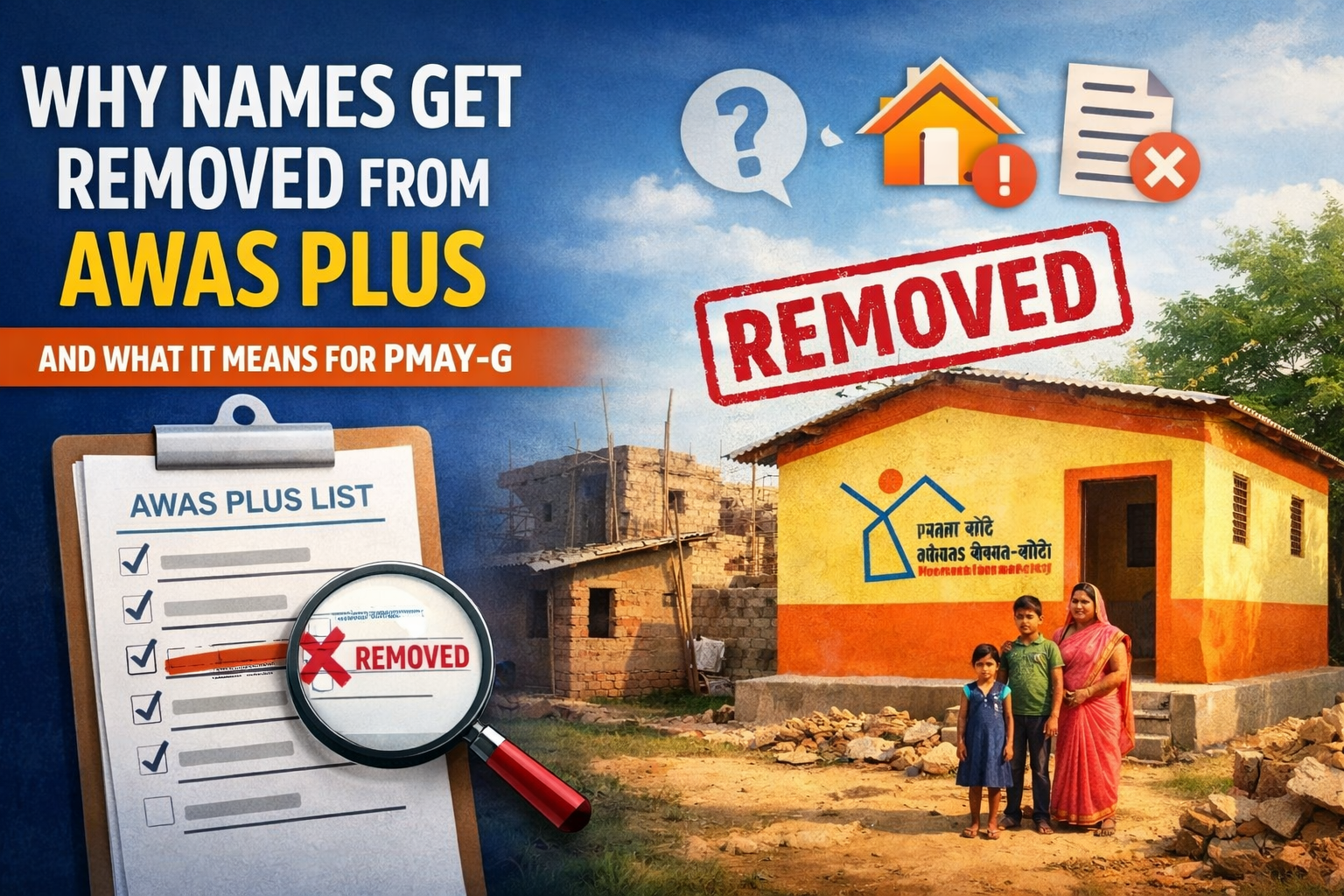
If your household name was earlier included in housing records but is no longer visible after an Awas Plus survey, it can naturally create fear and confusion. Many families immediately worry that they have permanently lost their chance to receive a pucca house under government housing schemes.
In reality, name removal under Awas Plus is usually part of a verification and correction process, not an instant rejection. To understand what this means, it is important to first understand how Awas Plus works and why data is reviewed so carefully.
This article explains, in detail, why names are removed from Awas Plus, what each reason means in practical terms, and what steps rural households should take to protect their eligibility.
Understanding the Purpose of Awas Plus Verification
Awas Plus is a beneficiary identification and verification system linked to rural housing assistance under Pradhan Mantri Awas Yojana – Gramin (PMAY-G).
Its purpose is to ensure that:
- Only genuinely eligible rural households receive housing benefits
- Errors from older surveys are corrected
- Duplicate or incorrect records are removed
- Government resources are used fairly
Because of this role, Awas Plus regularly updates data based on fresh ground-level surveys.
What Does “Name Removal” in Awas Plus Actually Mean?
When a name is removed from Awas Plus records, it usually means that the household’s eligibility status has changed based on updated information, or that the data needs further verification.
It does not automatically mean that:
- The household is permanently rejected
- The family will never receive housing assistance
In most cases, removal indicates that something in the record requires clarification or correction.
Main Reasons Why Names Get Removed from Awas Plus
1. Change in Housing Condition
One of the most common reasons for removal is a change in the household’s housing condition.
If survey officials record that:
- The family now lives in a pucca house, or
- A permanent residential structure already exists in the household’s name
then the household may no longer qualify under deprivation-based housing criteria.
What this means for families:
Even partial improvements or incorrectly recorded house types can affect eligibility.
What to do:
Verify whether the recorded housing status accurately reflects reality. If incorrect, request a correction through the Panchayat.
2. Duplicate Household or Family Records
During fresh surveys, officials often detect:
- Multiple records linked to the same family
- Family members appearing in more than one household entry
- Duplicate records created during earlier surveys
To prevent misuse, one of the duplicate records is removed.
What to do:
Ask local officials which record has been retained and whether your household details need realignment.
3. Errors in Survey Data Entry
A large number of removals happen due to simple data errors, such as:
- Incorrect family size
- Wrong house classification
- Mistakes in ownership details
- Errors in location or geo-tagging
These mistakes are administrative, not intentional.
What to do:
Request a review of the survey data and submit correct information through official channels.
4. Household Not Covered During Survey Visit
Some households are marked unverified because:
- No one was present during the survey visit
- The house was locked or inaccessible
- Address details were unclear
Without verification, records may be temporarily excluded.
What to do:
Ask whether a re-survey can be scheduled or whether verification is still pending.
5. Updated Eligibility Assessment
Eligibility under rural housing schemes is determined using multiple socio-economic indicators, not income alone.
If updated data shows that:
- The household owns assets that disqualify eligibility
- Living conditions no longer meet deprivation criteria
the record may be removed.
What to do:
Request clarity on the specific eligibility factor that affected your record.
6. Conflict Between Old and New Records
In many villages, older housing data exists alongside newer digital surveys. When inconsistencies appear, newer verified data takes priority, and older records may be removed temporarily.
What to do:
Ensure your most recent household details are correctly recorded.
7. Administrative Review or Audit Process
Sometimes names are removed during:
- Block-level audits
- Data clean-up exercises
- District-level reviews
In such cases, records are rechecked before final approval.
What to do:
Confirm whether your name is under review rather than rejected.
What Rural Families Should Do If Their Name Is Removed
If your name does not appear in the updated list, follow these steps calmly:
- Visit your Gram Panchayat office
- Ask whether your household was surveyed
- Request the exact reason for removal
- Submit correction details if required
- Follow guidance provided by block officials
Avoid relying on informal sources or rumours.
Does Name Removal Affect PMAY-G Housing Benefits?
Yes, but indirectly.
Only households that clear Awas Plus verification are considered for benefits under PMAY-G. If verification is pending or incorrect, benefit approval may be delayed, not cancelled.
Warning About Middlemen and False Claims
Some individuals claim they can:
- Restore removed names
- Guarantee approval
- Speed up verification
These claims are false. Awas Plus decisions are made only through official government processes.
How Long Does Correction or Re-Verification Take?
There is no fixed timeline. The process depends on:
- Survey schedules
- Administrative workload
- Accuracy of submitted corrections
Patience and proper documentation are essential.
Final Conclusion
Names are removed from Awas Plus mainly because of:
- Data mismatches
- Verification gaps
- Updated eligibility assessment
In most cases, removal is part of a correction process, not a final denial.
Understanding the reason clearly and following official procedures is the best way for rural households to protect their housing eligibility.